
Foldable phones have spent years running into the same physical limit. Every millimeter taken up by the hinge, two displays, and structural reinforcement leaves less room for the battery. Samsung’s July 22 Galaxy Unpacked event brought that trade-off back into focus. The Galaxy Z Fold8 lineup announcement emphasized slimmer designs and larger batteries, while early testing pointed to silicon-carbon battery technology as a key part of that shift.
A bigger battery without a thicker Fold
The standard Galaxy Z Fold8 carries a 4,800mAh battery, up from the 4,400mAh pack used in the previous Fold7. On paper, that might look like a routine specification bump. In a foldable, though, it matters more than it would in a conventional slab phone. Internal space is especially limited, and battery capacity has long been one of the category’s biggest compromises.
In its hands-on review, Tom’s Guide reported that the Fold8 is among Samsung’s first phones to use a silicon-carbon battery. The phone lasted 12 hours and 19 minutes in its web-browsing battery test, compared with 10 hours and 44 minutes for the Fold7. Test results will vary, but the broader direction is clear. Battery chemistry is becoming a more visible part of foldable phone design.
What silicon-carbon batteries change
Most lithium-ion batteries depend heavily on graphite in the anode, the part of the cell that stores lithium ions while charging. Silicon can hold far more lithium than graphite. Adding it to a carbon-based anode can therefore increase energy density, giving manufacturers a chance to fit more capacity into the same space or maintain capacity while making a device thinner.
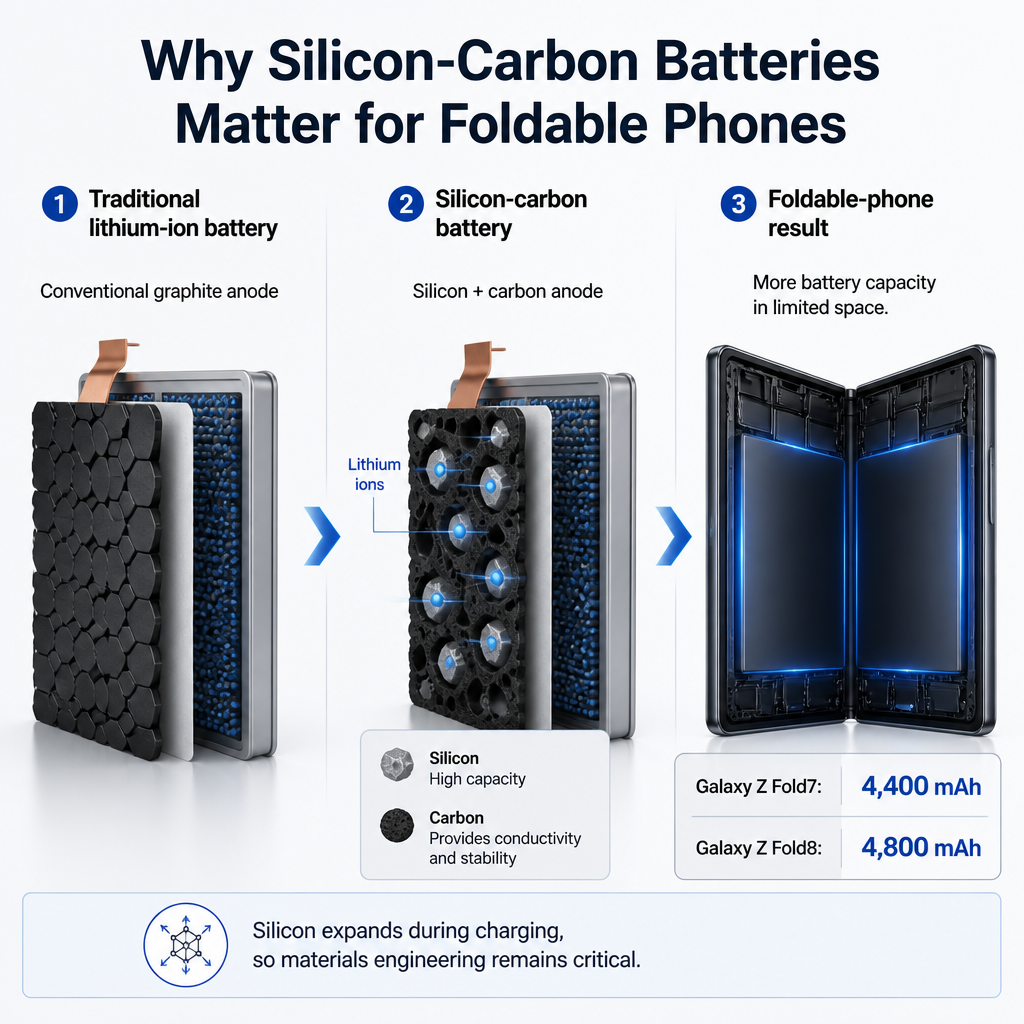
This isn’t a solid-state battery, and the usual limits of battery engineering still apply. Silicon expands considerably as it charges, which can reduce durability unless the materials are designed carefully. That’s why commercial phone batteries use silicon-carbon blends instead of replacing graphite with pure silicon. Samsung hasn’t disclosed the silicon content of the Fold8’s cell, nor has it issued a separate public cycle-life claim for the new chemistry.
Why foldables are an ideal early target
With a regular phone, manufacturers can sometimes accommodate a larger battery by making the body slightly thicker. Foldables have much less room for that solution. The hinge, split battery layout, and large internal display make every space-saving improvement valuable. Higher-density cells can offer more practical benefits than another small capacity increase achieved by simply enlarging the phone.
The shift extends beyond Samsung. Battery capacity is becoming a competitive differentiator again as phones gain brighter displays, faster chips, and more on-device AI features. All of those workloads make it harder for thin devices to last through a full day.
What comes next
The Fold8 won’t settle the battery race by itself. Its 4,800mAh capacity remains modest next to some larger-battery rivals, while charging speed, heat management, and long-term battery health matter just as much as the figure on a specification sheet. Still, Samsung’s adoption sends a meaningful signal. Silicon-carbon cells are moving from a specialist advantage into the mainstream premium-phone discussion. The next foldable contest may be decided less by the hinge and more by what manufacturers can fit behind it.
