
For years, item trackers have answered a broad question: Where was this last seen? Google’s new Pixel Tag is aimed at the next, more useful one: How far away is it right now?
Google announced its first finder tag on August 12, 2026, alongside the Pixel 11 lineup. Priced at $29, the Pixel Tag works with the Android Find Hub network. Its defining technical feature is the combination of Ultra-Wideband (UWB) and Bluetooth Channel Sounding for precision finding. Google says compatible Android phones can display visual distance and directional cues when the tag is nearby.
Bluetooth is getting better at measuring distance
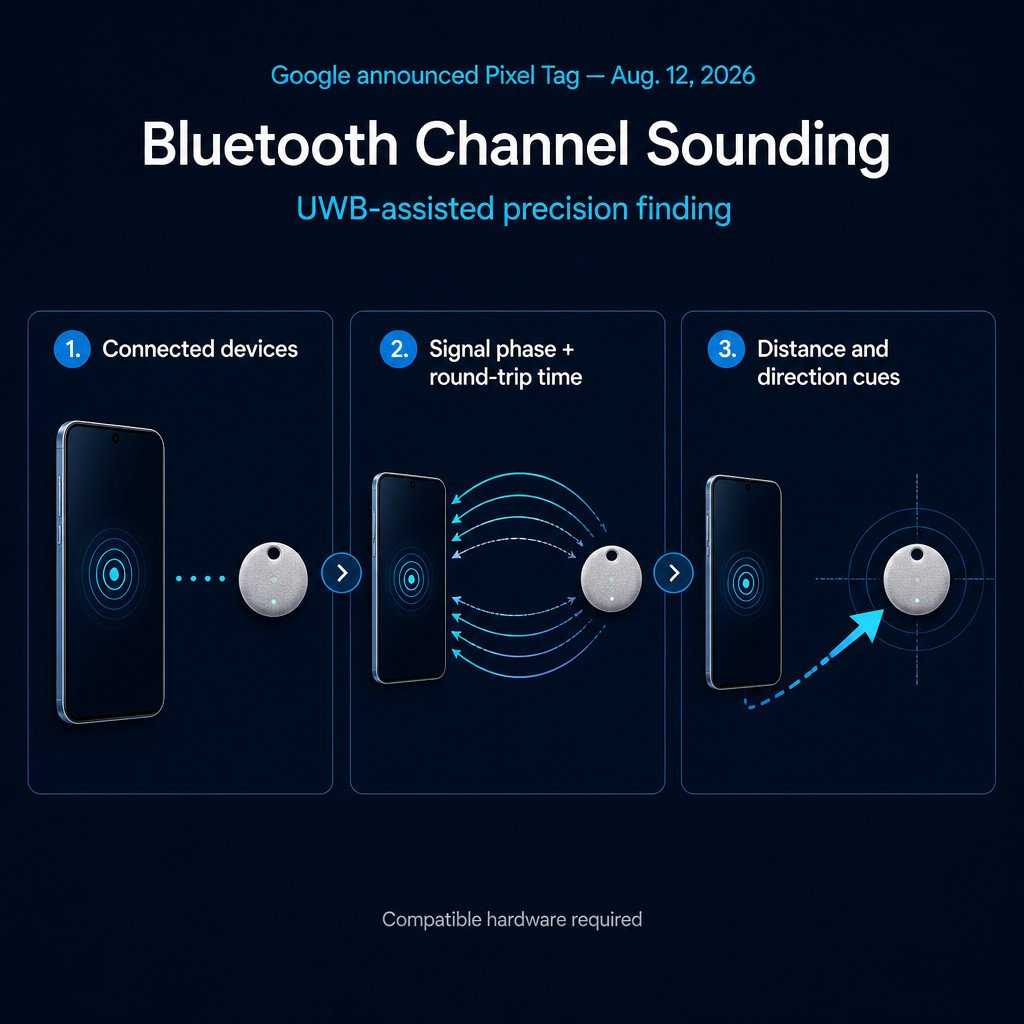
Traditional Bluetooth tracking can tell when something is close, but received-signal strength provides only a rough estimate. Walls, furniture, pockets and even how someone holds a phone can throw it off. Bluetooth Channel Sounding uses a more advanced method, examining the phase and travel time of radio signals exchanged across different frequencies to estimate distance.
According to the Bluetooth Special Interest Group, the feature combines phase-based ranging with round-trip timing. That timing can also help counter relay attacks designed to make a device appear closer than it really is. So this goes beyond a louder “hotter/colder” signal. The goal is to make Bluetooth a more dependable tool for short-range measurement.
Why the Pixel Tag matters now
UWB already supports highly precise finding on certain phones and trackers. The Pixel Tag stands out because Bluetooth Channel Sounding is appearing in a mainstream consumer product, rather than remaining a specification that’s still waiting for hardware support. Google is pairing a familiar type of tracker with a newer Bluetooth capability, giving the industry another option for precise ranging.
The Pixel Tag is also built for everyday use, not as a niche technology demo. It has a replaceable battery rated for up to one year, IP67 dust and water resistance, and shared access for as many as 10 people. A button on the tag can ring a paired phone. Google says it will go on sale on November 11, 2026, priced at $29 for one or $99 for a four-pack.
The shift toward distance-aware devices
The obvious use is finding keys buried under a sofa. The longer-term change is more interesting. If one device can securely determine that another is nearby, along with roughly how far away it is, interactions can feel more natural. A digital key could know that its user is standing beside a lock. Accessories could respond when they’re separated from a phone, while smart-home controls could work through proximity instead of taps.
None of that will happen automatically. Google says precision finding requires a compatible Android device with UWB support, and Bluetooth Channel Sounding also relies on newer hardware. Bluetooth’s own guidance indicates that existing products may need updated radio chips because the feature introduces a new protocol stack.
Even so, the Pixel Tag makes this shift easier to see. The tracker itself is familiar, but the radio technology inside it is changing. As more phones and accessories get the necessary hardware, Bluetooth may become less focused on connecting gadgets and better at helping them understand physical space.
