
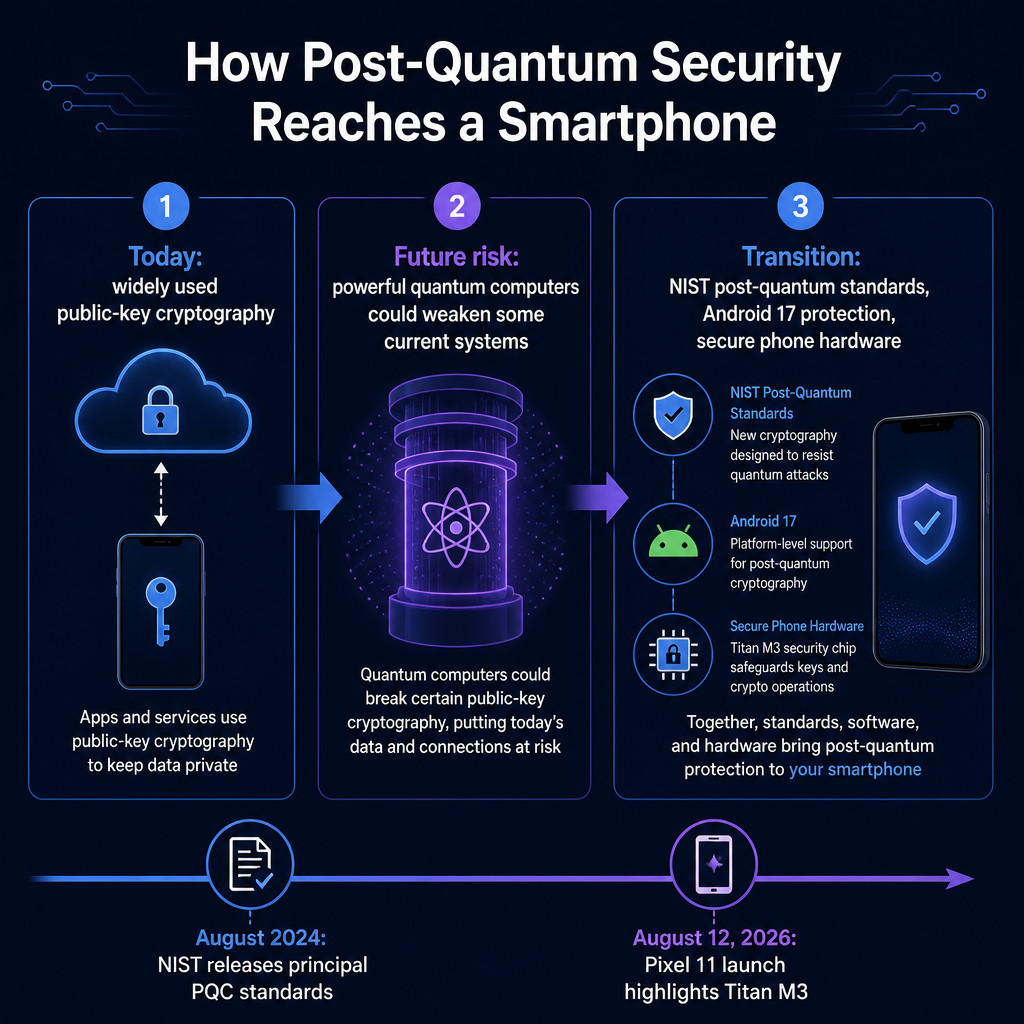
Cryptography rarely takes center stage at a new phone launch. At Google’s Pixel 11 event on August 12, it did. Alongside the cameras and AI features, Google drew attention to the Titan M3 security chip in the Pixel 11 family, saying it uses post-quantum cryptography standards developed by the US National Institute of Standards and Technology.
That turns the Pixel 11 launch into more than the usual annual spec-sheet update. It’s a sign that quantum-safe security is beginning to move beyond corporate infrastructure and into the consumer devices people carry every day.
Why smartphones are adopting it now
Post-quantum cryptography, or PQC, covers algorithms designed to resist attacks by a sufficiently capable future quantum computer. Those machines aren’t breaking mainstream encryption at scale yet, but the migration can’t wait until they are. Security systems, device makers and cloud platforms will need years to replace older cryptography without causing compatibility problems.
The immediate concern is often described as “store now, decrypt later.” Attackers could collect encrypted data today, then keep it in the hope that future computing advances will make it readable. The risk is greatest for information that needs to stay sensitive for years, including personal records, financial data, corporate secrets and government communications.
NIST released its first principal PQC standards in August 2024. They include ML-KEM for establishing encryption keys and ML-DSA for digital signatures. NIST says organizations should start moving to these standards now instead of treating quantum security as a distant research issue.
What the Pixel 11 changes
Google says Titan M3 works alongside the Tensor G6 chip, while Android 17 is adding ML-DSA protection for digital signatures. Pixel owners don’t suddenly need to understand lattice-based mathematics. What matters is that the security stack is being updated across several layers, including the operating system, authentication, hardware-backed protection and the services connected to them.
That approach is necessary because moving to post-quantum cryptography isn’t a matter of flipping one switch. Encryption protects data exchanges, while signatures help confirm that software, updates and services are authentic. Replacing one and leaving the other unchanged would create gaps.
Why it matters to phone buyers
For most buyers, a post-quantum chip won’t justify replacing a perfectly good phone. It doesn’t make a handset immune to phishing, malicious apps or weak passwords. Nor does it mean quantum computers are about to crack everyone’s messages tomorrow.
Still, security features usually become meaningful only once they’re widely deployed. Consumers have already seen fingerprint sensors, secure enclaves, hardware-backed passkeys and on-device AI shift from specialist terminology to standard phone features. PQC may take a similar route, first appearing as an invisible safeguard before becoming something buyers expect in a premium device.
Google has set a 2029 target for its broader PQC migration. NIST’s transition plan, meanwhile, calls for quantum-vulnerable algorithms to be phased out of its standards by 2035. The next question is whether other phone makers will turn that long-term deadline into visible hardware and software commitments of their own.
