For years, the laptop industry has focused on making computers thinner, lighter and increasingly difficult to repair. This week, Acer offered a notable counterpoint. Its new Vero 16 is built around the idea that a laptop should be opened, serviced and upgraded rather than discarded when a single part fails.
Announced on September 2, 2026, the Vero 16 makes repairability a central feature of a mainstream consumer laptop. Acer says it includes a tool-free access latch, a user-replaceable battery and a replaceable SSD. The I/O port covers are removable as well, and the hinge has been designed as a serviceable component.
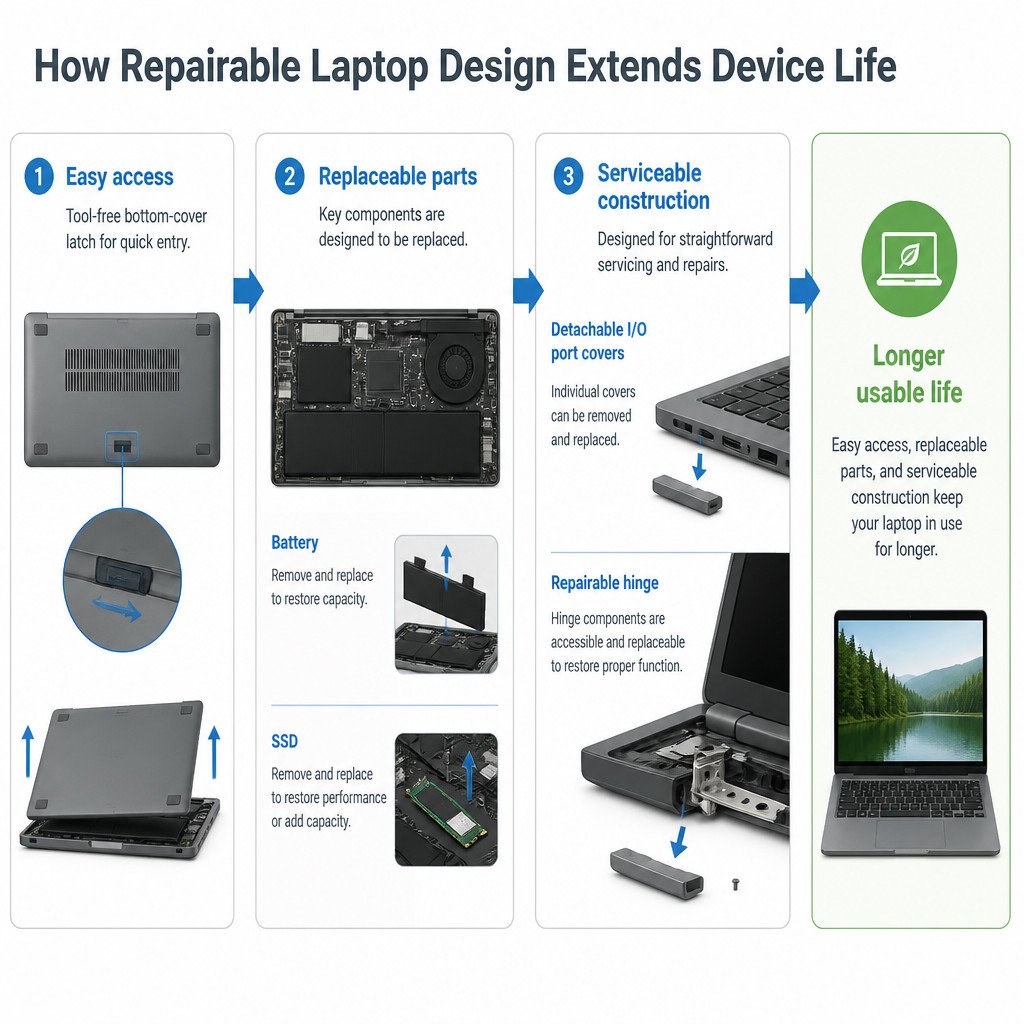
Those choices matter because laptops aren’t usually retired due to a dead processor. Batteries lose capacity, storage fills up or fails, and hinges wear out. Ports can also become damaged. If those parts are difficult or too expensive to replace, an otherwise capable computer can quickly become electronic waste.
Acer’s announcement goes beyond another sustainability claim. It presents repairability as a product feature alongside performance, display quality and artificial intelligence. The Vero 16 is still being marketed as a Copilot+ PC, complete with Intel Core Ultra processors and a 16-inch OLED display. The point is clear: easier repairs don’t have to come with low-end hardware.
Why repairability is gaining attention again
The timing matters. Laptop makers are adding more AI capabilities, while many buyers are questioning whether modest performance gains justify replacing a computer every few years. A repairable design offers another path. Owners can keep the same machine and replace only the part that needs work.
It may also affect how people compare laptops. Rather than focusing only on processor speed or first-day battery life, shoppers could increasingly ask if the battery is replaceable, if the storage is soldered, and how easily a damaged hinge or port can be serviced.
Acer says the Vero 16 builds on its earlier reduce, reuse and recycle approach by adding a fourth principle, repairability. Parts of the chassis use recycled and low-carbon aluminum, while other components contain recycled plastic. The packaging is recyclable too. Those material choices have value, though the more practical environmental benefit may come from keeping the laptop in use for longer.
What comes next
The Vero 16 is expected to reach Europe, the Middle East and Africa in the first quarter of 2027. Regional pricing and availability have yet to be confirmed.
Its success will depend on more than the design itself. The availability of replacement parts and repair guides, along with reasonable service costs, will determine whether Acer’s promise holds up during everyday ownership.
Even so, the announcement is a meaningful sign of where laptop design may be heading. As computers grow more powerful and expensive, repairability is moving beyond a niche concern for enthusiasts and becoming a mainstream selling point.
Acer’s IFA 2026 product page and its announcement describe the Vero 16 as a laptop designed for both AI performance and longer-term serviceability.