
Wireless earbuds have become one of the most disposable categories in consumer tech. They’re compact, convenient and increasingly expensive. Yet once their tiny lithium-ion cells lose capacity, replacing the entire set is often easier than trying to repair it.
That’s why Sennheiser’s August 21 launch of the MOMENTUM True Wireless 5 matters beyond the usual cycle of headphone specifications. According to the company, its new flagship earbuds have replaceable batteries in both earpieces and the charging case. It’s a small design choice with a much larger implication: premium earbuds may be starting to treat the battery as a serviceable part rather than a built-in expiry date.
The battery is becoming part of the buying decision
Battery life is usually one of the headline figures for wireless earbuds. Sennheiser says the MOMENTUM True Wireless 5 can provide up to 12 hours per earbud and up to 40 hours with the charging case. But a long runtime on day one doesn’t guarantee a long usable life. Rechargeable batteries lose capacity over repeated charge cycles, eventually turning otherwise functional earbuds into drawer clutter.
Giving owners a way to replace the battery changes what they’re paying for. Instead of asking only whether a pair will last through a long flight, buyers can consider whether it will remain useful for several years. For a device that’s carried and charged almost every day, that’s a more meaningful measure of durability.
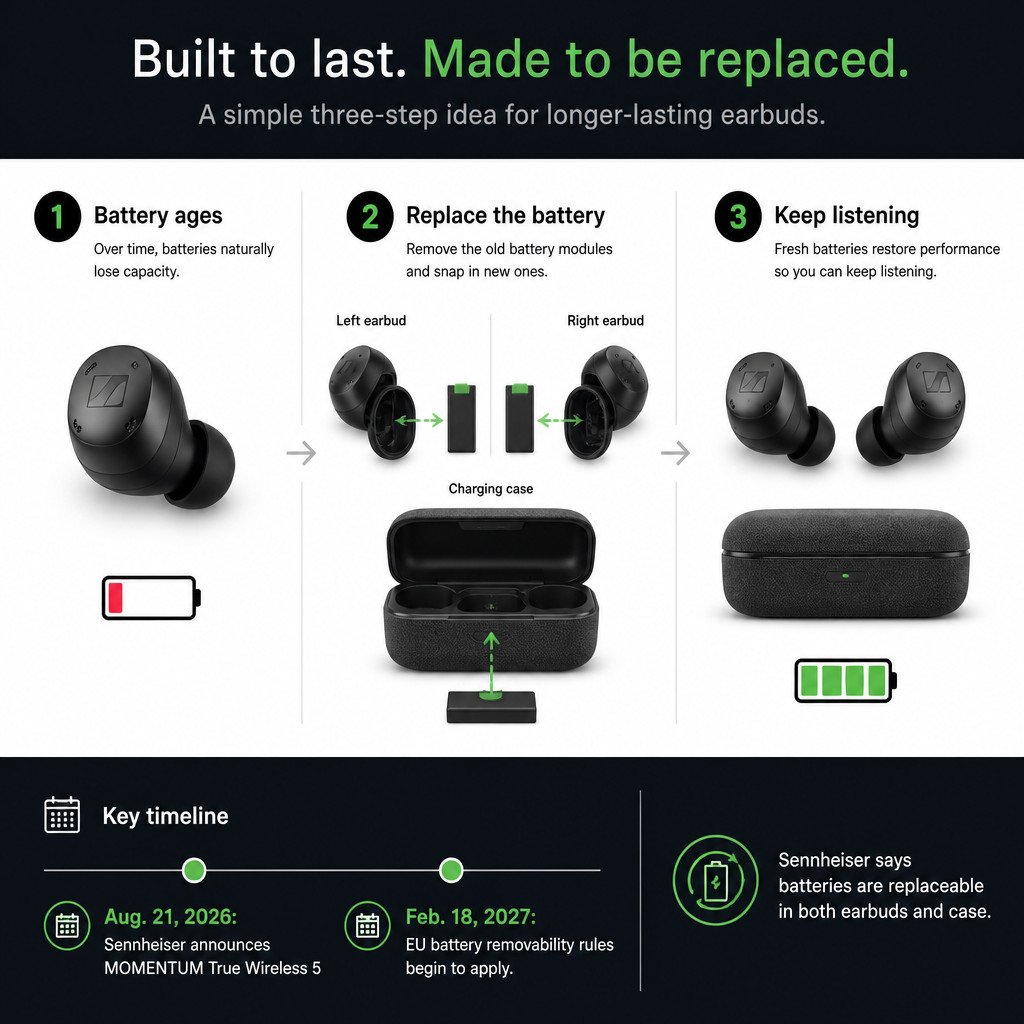
Why this is happening now
The timing comes shortly before a major regulatory change in Europe. Article 11 of the EU Batteries Regulation is scheduled to apply from February 18, 2027. In general, it requires portable batteries in products sold in the EU to be readily removable and replaceable by end users. That doesn’t mean every tiny gadget will need the same repair design. In July 2026, the European Commission added exemptions for several categories, including some wearable devices.
Even so, the direction is clear. Regulators are pressing manufacturers to make electronics easier to maintain and recycle, while consumers are paying more attention to the cost of sealed batteries. Sennheiser hasn’t presented the earbud design as a response to the regulation, but the product arrives just as repairability is becoming a more visible competitive feature.
Small hardware makes repair difficult
Making a battery replaceable inside an earbud is harder than doing the same thing in a laptop. The enclosure still needs to be comfortable, compact and resistant to everyday sweat and dust. At the same time, the battery connection must remain safe and reliable. Sennheiser lists an IP54 durability rating for the earbuds, highlighting the trade-off: repair access can’t come at the cost of everyday resilience.
That tension is what makes this launch notable. Repairable phones and over-ear headphones already exist, but true wireless earbuds are among the most space-constrained devices people own.
The next sign to watch for is whether rival audio brands follow with batteries that can be replaced in both the earbuds and the case. If they do, “how long will this last?” could become as important as sound quality and noise cancellation.
