
Virtual reality is taking on a practical role in robotics as a way to teach humanoid robots how to move.
The immediate trigger is Teleopit, a humanoid teleoperation system detailed in a research preprint published on August 3, 2026. Instead of using VR to place someone inside a virtual environment, Teleopit maps an operator’s body, hand and head movements onto a real humanoid robot. Remote control isn’t the end goal. The system is designed to collect the physical demonstrations robots need to learn useful tasks.
VR is becoming a robot-teaching tool
Training humanoid robots is difficult because real-world work involves much more than picking up an object. A robot might have to shift its weight, look toward the right surface, position its arms and move individual fingers in a coordinated sequence. Programming each motion by hand doesn’t scale well, and collecting high-quality task examples remains a major bottleneck.
Teleopit approaches the problem by taking signals from a VR setup and translating them for a humanoid body, dexterous hands and an active vision module. The researchers also added a motion tracker and developed a hand-retargeting method that maps human finger movements to different robotic hands without requiring task-by-task tuning.
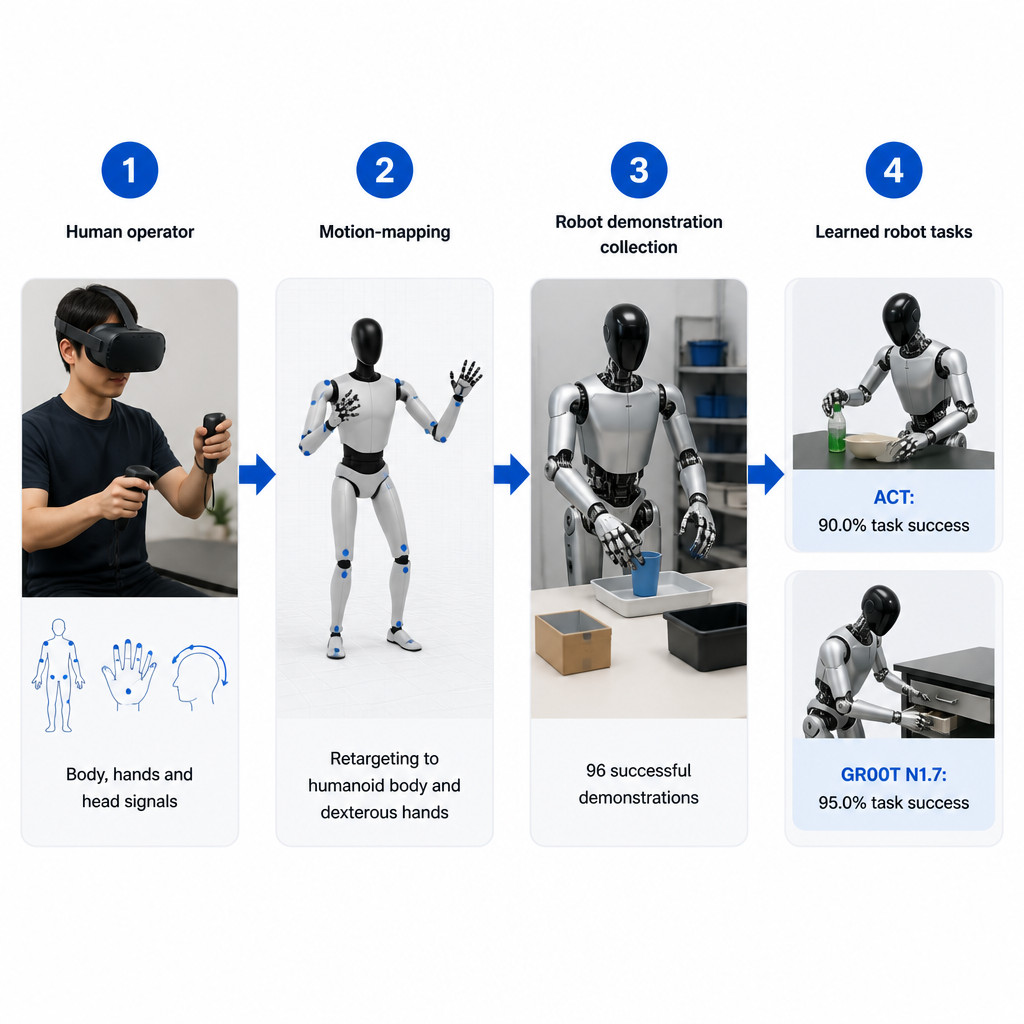
That lets the human operator demonstrate an entire action naturally. The resulting example captures posture, hand movement and viewpoint, rather than giving the robot a narrow instruction such as “move gripper left.”
The real result is training data
The Teleopit team collected 96 successful demonstrations, then used them to train two robot-learning policies. In reported tests on real robots, the system reached 90.0% task success with an ACT policy and 95.0% with NVIDIA’s GR00T N1.7 policy. Those results apply to the researchers’ particular setup and demonstrations, not to every humanoid task. Still, they show where the technology is heading: richer human demonstrations can lead to more capable robot behavior with fewer hand-written rules.
That’s why teleoperation is becoming a major area of physical AI research. The valuable output isn’t a person piloting a robot from a distance forever. It’s the collection of examples created during that process. Imitation-learning systems can train on those examples and later operate with greater independence.
Why progress is speeding up now
The necessary hardware and software are starting to come together. Consumer VR has made head and hand tracking more accessible, while robotics teams are developing machines that can handle perception and decision-making locally. NVIDIA’s July 15 launch of new Jetson Thor modules points in that direction. The company is targeting compact edge computing for robots and visual AI systems, rather than focusing only on giant data centers.
For readers, the takeaway is straightforward. The next leap in humanoid robotics may not come from robots suddenly “understanding” the world by themselves. Better tools for showing them how the physical world works could matter more.
Expect to see more systems combining VR, wearable tracking and imitation learning. The race increasingly comes down to who can collect safe, varied and reusable real-world robot-training data the fastest.
