
Formal verification is drawing renewed attention after Google DeepMind said on November 10, 2026, that its AlphaProof Code system helped mathematically verify key security properties in the implementation behind Signal’s cryptographic protocol. The announcement stands out because it puts the focus on a software-security method that has long been slow, specialized and costly. (deepmind.google)
What Is Formal Verification?
Formal verification checks software with mathematics, rather than relying solely on conventional testing. Engineers begin by defining exact requirements in a formal language, such as “a message remains confidential under these conditions.” They then use a theorem prover, a program that checks logical proofs, to determine whether the code meets those requirements.
A standard test tries selected inputs and looks for failures. A formal proof, by contrast, can cover every behavior represented in the model. That makes a difference for software in which an uncommon mistake could have serious consequences, including cryptographic libraries, processor designs, aircraft controls and medical-device firmware.
How Formal Verification Works
The work starts with a specification, an exact, machine-readable account of what the software must and must not do. The program’s logic is then expressed in a form the verification tool can examine. A theorem prover checks a sequence of proof steps to show that the implementation satisfies the specification.
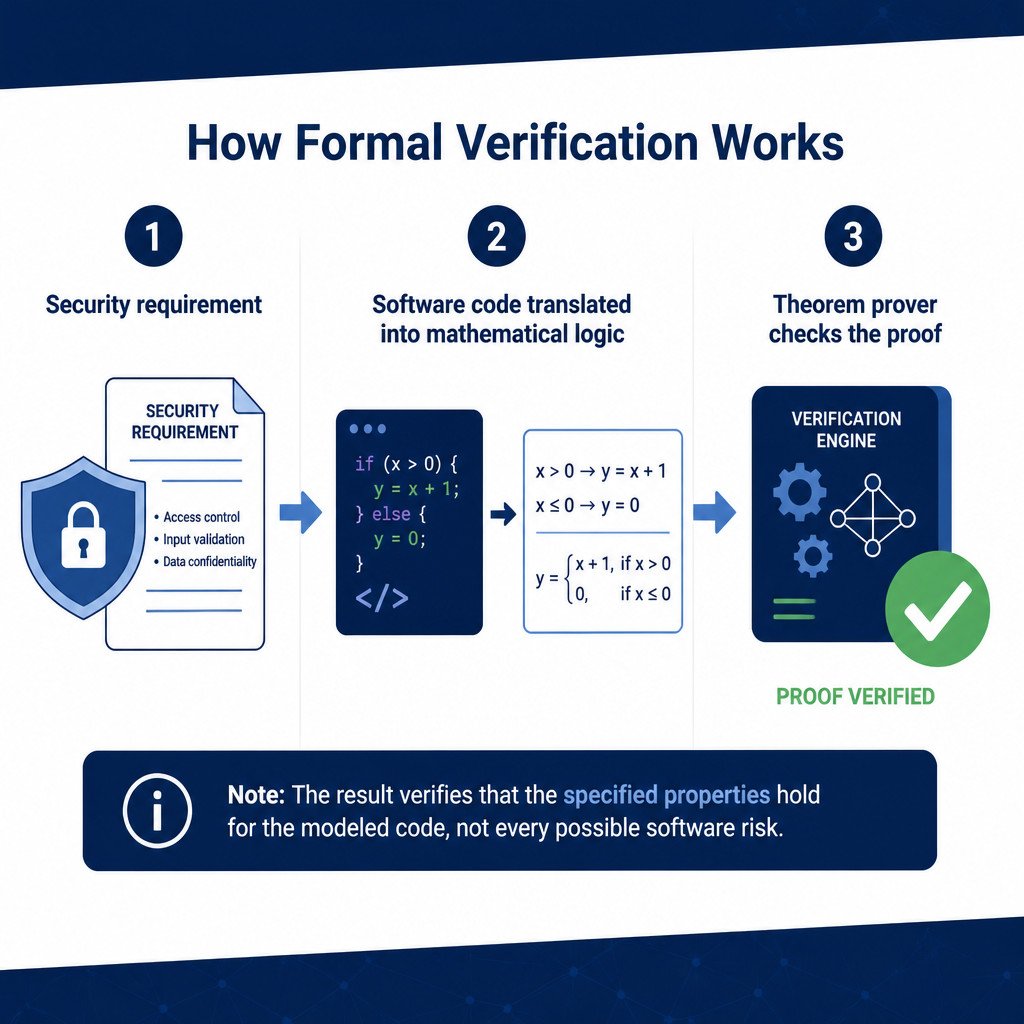
Modern tools can automate parts of the process, but people still play an essential part. A proof is only as sound as its specification and assumptions. If engineers define the wrong security property, or omit an important part of a system, a successful proof doesn’t mean the whole product is safe.
Why It Matters
Traditional testing can expose bugs, yet it usually can’t prove that a particular class of bug is impossible. Formal verification provides stronger assurance for tightly defined properties and can help teams uncover gaps between a system’s intended design and its actual implementation.
It doesn’t replace code review, penetration testing or security updates. Instead, it adds rigorous evidence in cases where failure carries a high cost. AI-assisted proof tools may make formal methods more practical for larger codebases, though their output still requires independent machine checking and expert oversight.
