
LTPI is drawing attention in AI-server infrastructure after Lattice Semiconductor and Arm said on October 7, 2026, that their joint server platform uses the interface for Open Compute Project-compatible connectivity. The name means LVDS Tunneling Protocol and Interface, and it addresses a practical issue in modular data-center servers: reliably moving many small control signals between separate hardware modules.
What LTPI Is
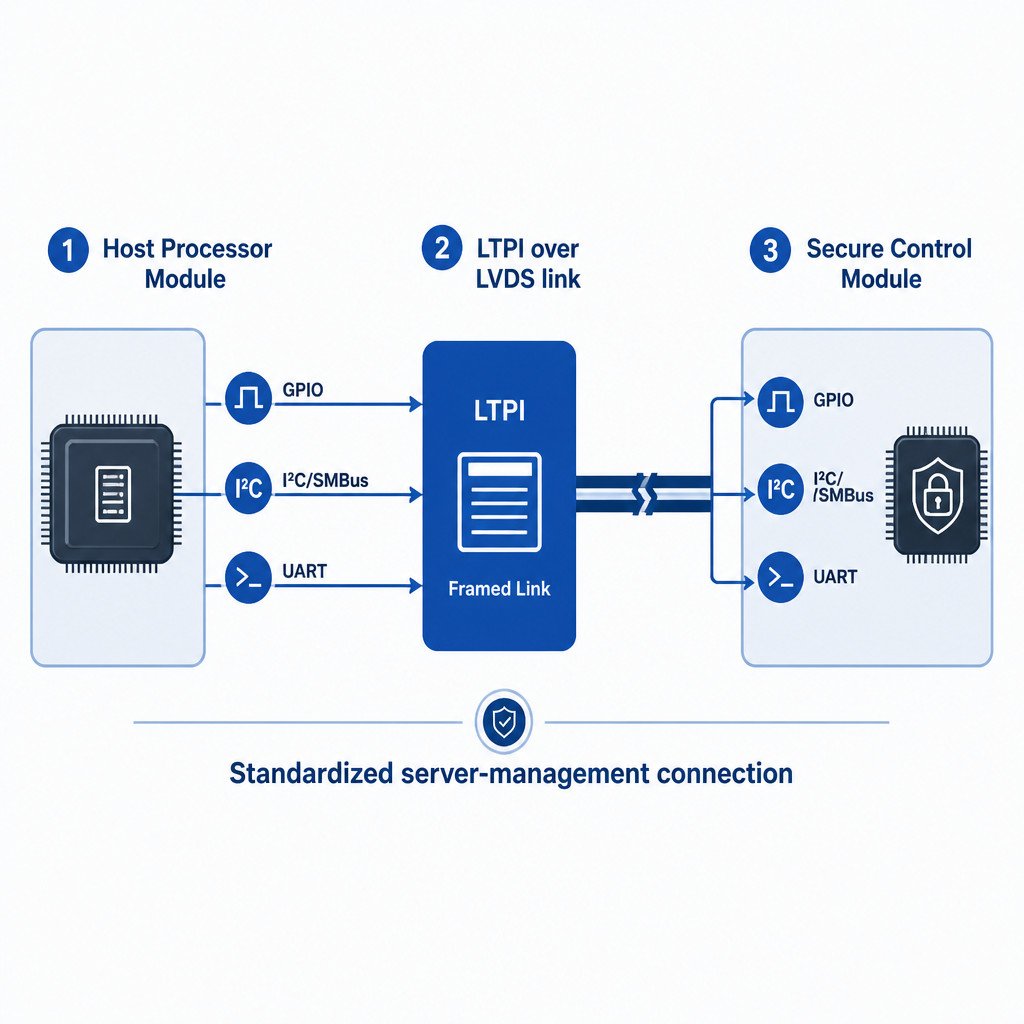
LTPI is an Open Compute Project (OCP) interface specified for the Data Center Secure Control Module, or DC-SCM, architecture. It links a server’s Host Processor Module (HPM) and Secure Control Module (SCM).
The two modules have different roles. The host module contains the main compute platform, while the control module handles functions such as platform management, monitoring, and startup control. Instead of needing a separate physical connection for every low-speed signal, LTPI moves those signals over a standardized link.
How LTPI Works
LTPI takes low-speed interfaces, including GPIO pins, I2C or SMBus management connections, UART serial data, and custom control channels, and maps them into framed data. That data is sent over LVDS, or low-voltage differential signaling, between programmable logic on the two modules.
In practical terms, LTPI works as a compact transport service for server-control traffic. It bundles multiple management connections for transmission across a small number of differential links, then rebuilds them at the other end. Before regular control traffic starts, the protocol also establishes the connection and configures the link.
Why It Matters
Servers are becoming more modular. An operator may want to update a processor board without redesigning the management hardware, or use the same control module across several server designs. A standard interface cuts down on dedicated wiring and helps components from different suppliers work together.
That matters in AI data centers, where servers need to bring together CPUs, accelerators, networking, and management hardware at scale. LTPI doesn’t carry the large AI data flows themselves. Instead, it supports the lower-speed control paths that let a server boot, report its status, and be managed securely.
Why LTPI Is Getting Attention Now
Lattice and Arm highlighted LTPI in their October 2026 AI-infrastructure collaboration ahead of the OCP Global Summit. The renewed attention reflects a broader move toward open, interchangeable building blocks for fast-growing data-center systems.
