
An optical discrete Fourier transform performs a Discrete Fourier Transform (DFT) with light instead of electronic circuits. A DFT is a mathematical operation that separates a complex signal into its underlying frequencies. It’s widely used in image processing, communications, scientific simulation, and data analysis.
The concept has drawn fresh attention since German photonic-computing company Q.ANT introduced its NPU Gen 2+ processor on November 17, 2026. The processor is designed to carry out DFTs directly in optical hardware. Q.ANT also demonstrated it operating alongside an AMD GPU in a language-model system.
What Is an Optical Discrete Fourier Transform?
On a conventional computer, a DFT requires many electronic operations. An optical DFT uses the physical properties of light instead. Light waves can interfere, combine, and shift phase in ways that naturally represent parts of a Fourier-transform calculation.
That doesn’t mean an entire workload runs on light. Photonic hardware is generally used as a specialized co-processor. CPUs and GPUs still handle software, memory, control, and other calculations, while the optical processor takes on selected operations.
How Does It Work?
Input data is encoded into light, often by changing properties such as intensity or phase. The light then moves through precisely designed components on a photonic chip. These components alter the waves so their output corresponds to the transform. Sensors convert the resulting optical signals back into electronic data for the rest of the system.
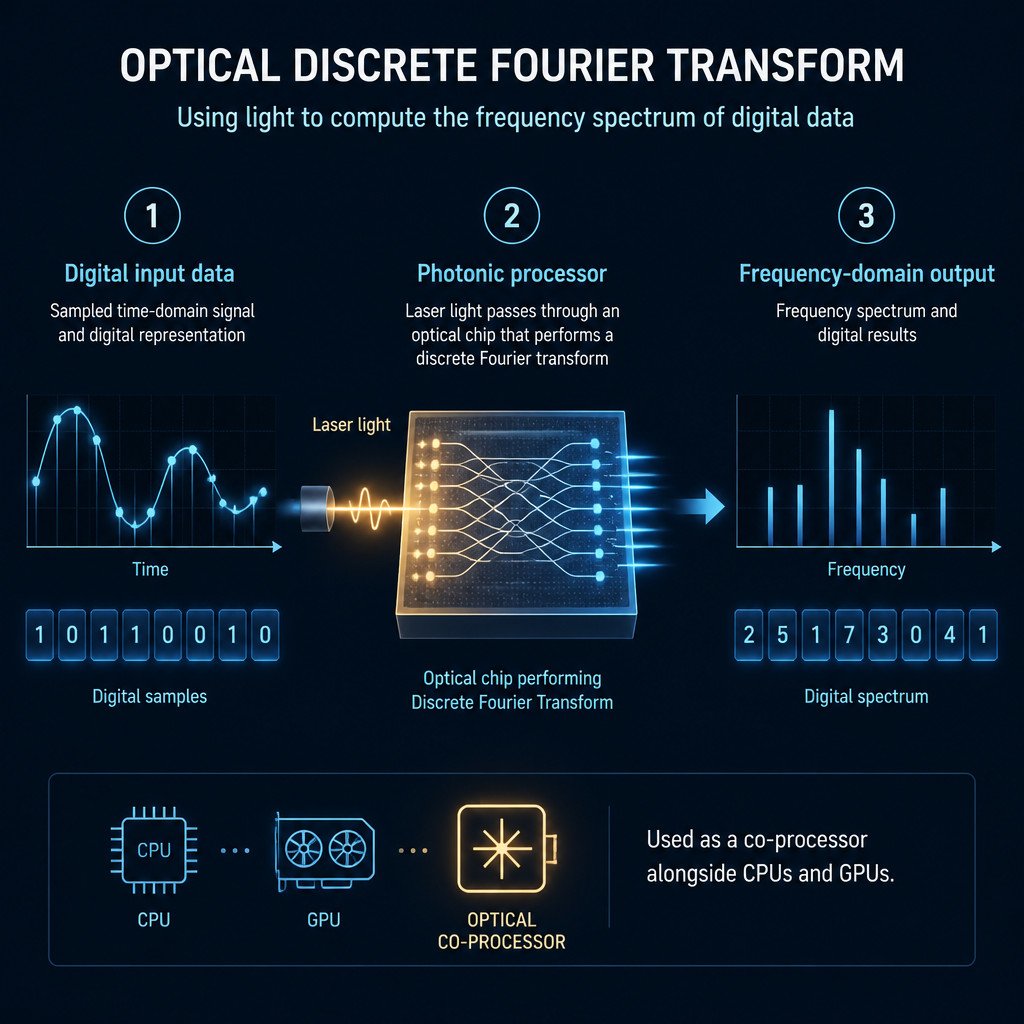
Because the transformation is created by the optical system itself, a photonic processor may avoid the lengthy sequence of electronic steps normally needed for the same operation. Still, the real-world result depends on the full system, including data movement and conversion between electronic and optical signals.
Why Does It Matter?
Fourier transforms appear in data-heavy workloads such as medical imaging, radar, video processing, simulations, and some experimental AI architectures. Performing selected transforms in photonic hardware could give developers another way to ease pressure on conventional processors.
For AI, the near-term opportunity is hybrid computing rather than replacing GPUs. Optical DFT hardware remains an emerging approach, but recent demonstrations suggest that computing with light could become useful for specific, mathematically intensive parts of AI and high-performance computing.
