
AI systems are increasingly running into memory limits, not just a lack of processing power. On November 16, Penguin Solutions introduced a planned photonics-based memory appliance built with Marvell technology, drawing new attention to photonic memory disaggregation, an approach that uses optical links to let several servers share large memory pools.
What Photonic Memory Disaggregation Means
Photonic memory disaggregation moves some memory away from an individual computer or GPU server and into a shared pool. Rather than having every accelerator depend solely on memory located directly beside its processor, eligible servers can tap into extra capacity through an optical fabric.
“Photonic” refers to sending data as light through optical components and fiber, instead of relying only on electrical signals carried over copper traces and cables. The idea is to extend high-bandwidth memory access farther than conventional electrical links can efficiently support.
How It Works
A photonic memory system brings together memory modules, optical input/output hardware, network interfaces, and management software. GPUs and CPUs connect to the fabric, which routes requests to available memory in the shared pool.
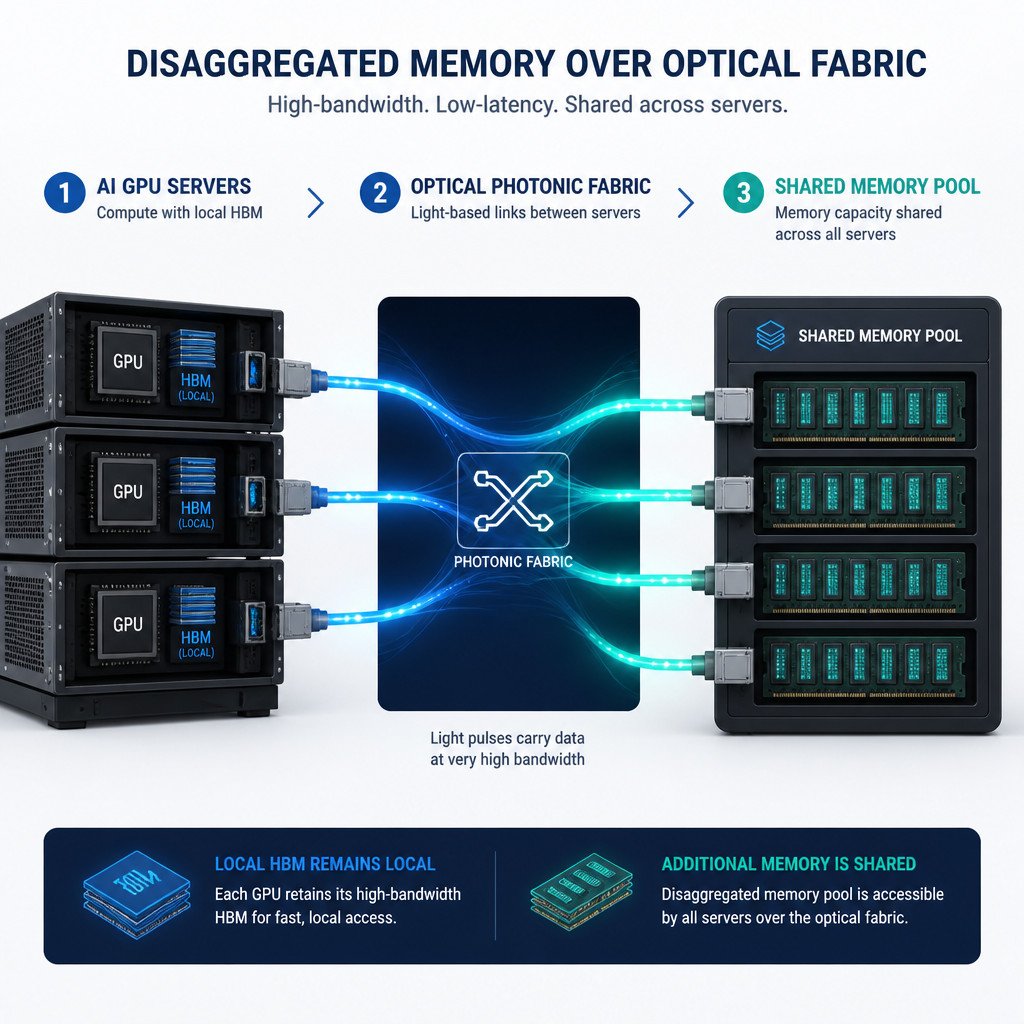
Local high-bandwidth memory attached to a GPU still matters for the most latency-sensitive tasks. Shared memory serves as an added tier, holding larger data sets such as the KV cache that language models use to retain context while generating responses. Software can assign capacity to the machines that need it, rather than leaving memory stranded on less-busy servers.
Why It Matters
Modern AI inference can demand a great deal of fast memory, particularly as models handle longer conversations, more users, or tool-using agents. Adding GPUs doesn’t automatically fix the issue because each accelerator has a fixed amount of closely attached memory.
Memory disaggregation is meant to let capacity scale more independently of compute. If optical links can deliver enough bandwidth with sufficiently low delay, operators may get more use out of existing accelerators while avoiding the need to build as many duplicate memory pools. It’s still an emerging data-center architecture, not a consumer-device feature, and its practical value will depend on hardware costs, software support, and workload behavior.
Why People Are Talking About It Now
As memory demand grows, AI infrastructure companies are looking beyond faster chips. The recent Penguin Solutions and Marvell announcement is a visible example of that shift, presenting optical shared memory as a possible way to address the AI “memory wall” across multiple racks.
