Virtual patching is drawing renewed attention as the time between the discovery of a software weakness and attempts to exploit it keeps shrinking. On September 1, 2026, security company F5 announced new automated virtual-patching capabilities for its web application firewall products. The move reflects a broader need to protect applications while permanent fixes are being developed.
What Is Virtual Patching?
A virtual patch is a temporary security rule designed to stop attackers from exploiting a known or suspected vulnerability without altering the vulnerable application code. It’s commonly enforced through a web application firewall (WAF), a security layer that sits between an internet-facing application and incoming traffic.
Unlike a conventional patch, a virtual patch doesn’t repair the underlying bug. It blocks the malicious request pattern that would trigger the flaw instead. This allows the application to stay online while developers investigate the problem, test a solution, and release a proper fix.
How Does Virtual Patching Work?
A security team first identifies a weakness through scanning, testing, vendor advisories, or signs of an attack. The team then creates or enables a targeted WAF rule. That rule checks requests headed for the affected application or API and rejects any that match the exploit technique before they can reach the vulnerable code.
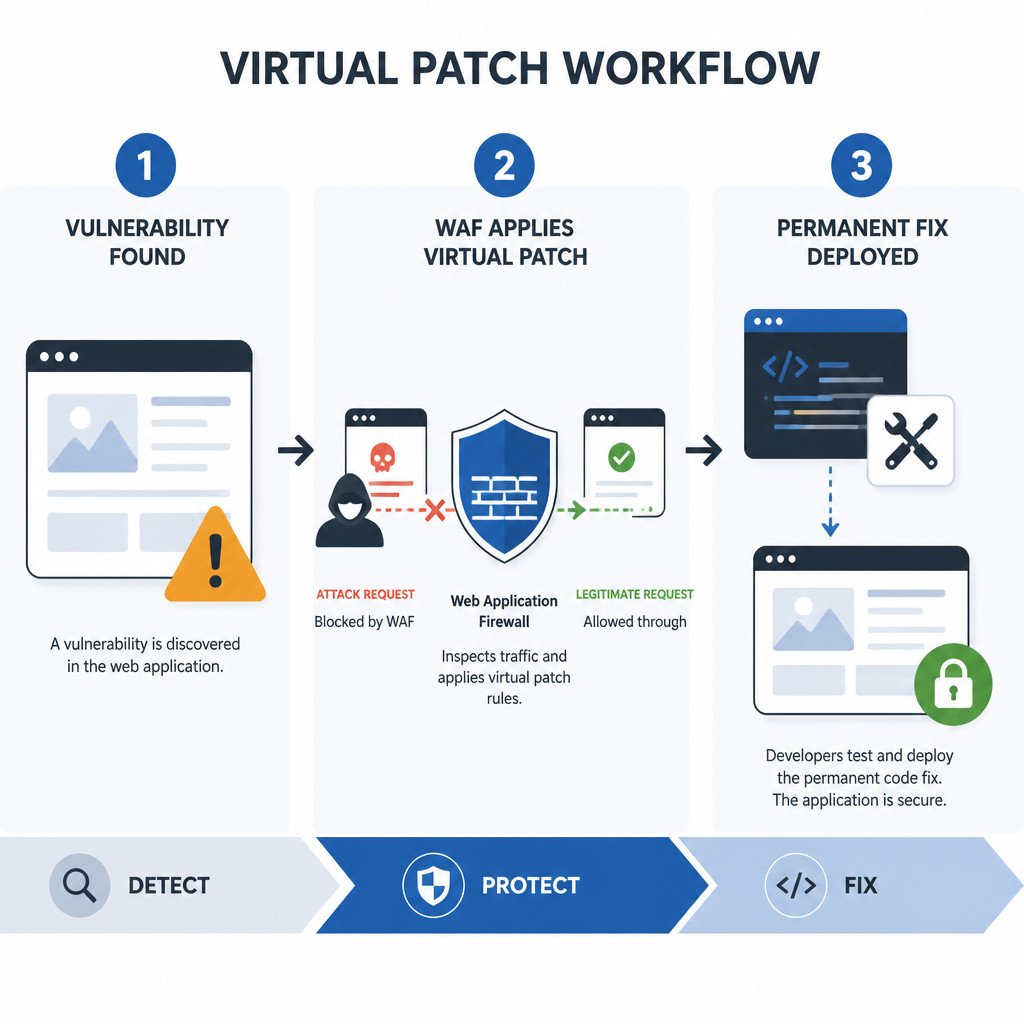
For example, an attacker might send specially crafted input intended to exploit a login form. The WAF can stop that input at the application’s edge while allowing legitimate requests to pass through. Teams still need to monitor the rule carefully, however, so normal users aren’t blocked by mistake.
Why Virtual Patching Matters
Changing application code can take time. The process may involve development work, quality testing, maintenance windows, and approval from business or compliance teams. That delay creates particular risk for legacy systems and critical services that can’t easily be taken offline.
Virtual patching reduces exposure during this gap. It’s especially useful for web applications, APIs, cloud services, and third-party components that a company can’t modify right away. But it remains a compensating control, not a replacement for remediation. Attackers may discover another route to the same flaw, which means the permanent software update is still essential.
Why It Is Getting Attention Now
Security vendors are placing more emphasis on runtime defenses as automated tools make probing applications and adapting attack techniques easier. Virtual patching lets defenders respond quickly at the traffic layer while engineering teams safely address the root cause.