
eBPF is getting fresh attention after OpenAI and Cisco announced Shirudo on November 23, 2026. The open-source project uses eBPF to help protect active Linux systems while permanent security patches are still being prepared. Shirudo is the announcement, but eBPF is the technology that makes those targeted, live controls possible.
What Is eBPF?
eBPF is a Linux kernel technology that allows approved small programs to run at specific points within the operating system. The kernel is the core software layer responsible for hardware, networking, memory, and running applications. Since it can observe so much of a machine’s activity, it’s a powerful place to measure, filter, or secure what happens on the system.
In the past, changing kernel behavior could mean altering kernel code, installing a kernel module, or restarting the system. eBPF offers a more flexible approach. Developers can attach a compact program to an event, such as an incoming network packet, a process launch, or a system call.
How eBPF Works
An eBPF program is loaded by regular user-space software, then runs when its assigned kernel event takes place. Before it runs, Linux checks it through an eBPF verifier. The verifier rejects programs that don’t meet the kernel’s safety limits, helping prevent unsafe memory access or code that could run indefinitely.
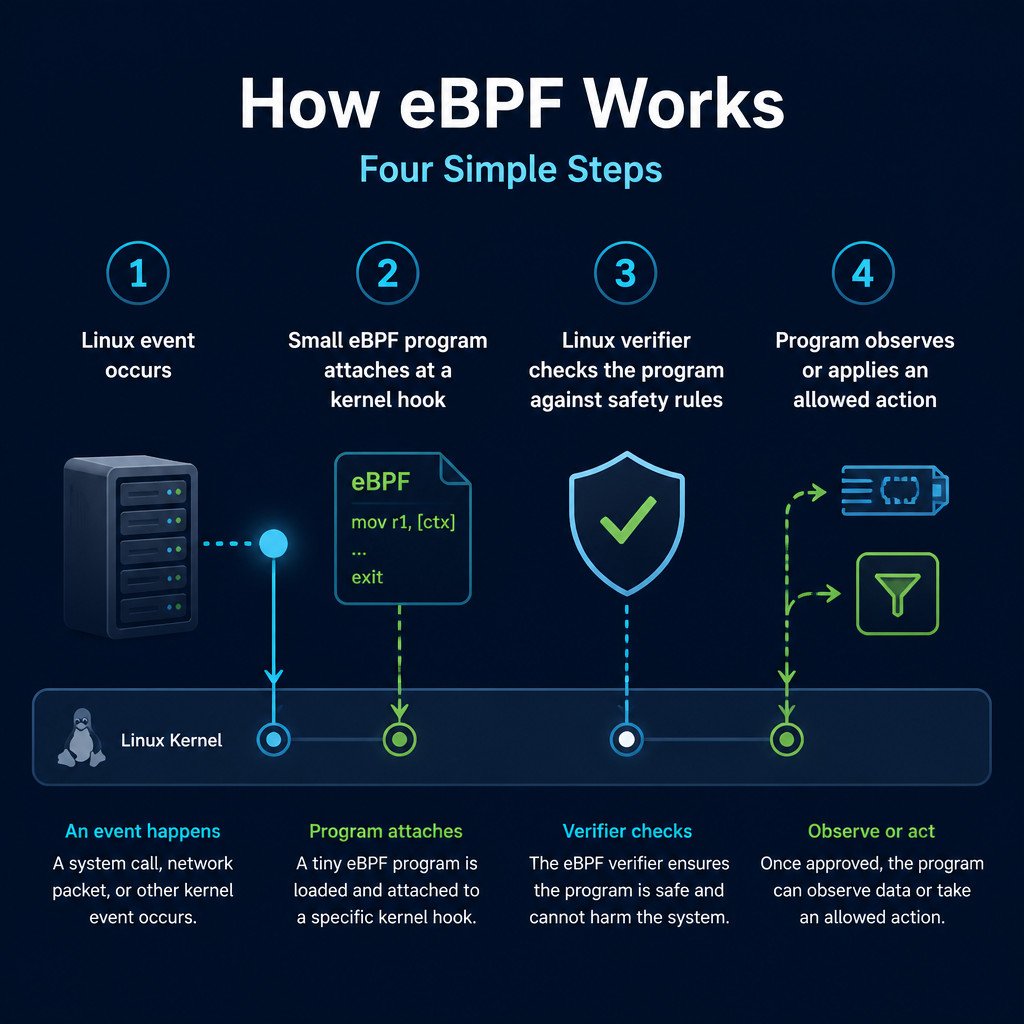
Programs can also use maps, structured stores that share data with user-space tools. An observability tool, for instance, can collect request-timing data. A security tool can watch for suspicious behavior and enforce a narrowly defined rule.
Why It Matters
eBPF can offer deep visibility and fast enforcement without putting agents inside every application or taking a server offline. It’s used for cloud networking, performance monitoring, troubleshooting, and runtime security.
Its security role is especially relevant now. A targeted eBPF control may block a vulnerable code path while a team tests and deploys a full patch. It doesn’t replace patching, and eBPF programs still need careful permissions and review. But it can narrow the dangerous gap between finding a flaw and fixing every affected system.
