AI inference accelerators are drawing fresh attention as companies search for cheaper, more power-efficient ways to run generative AI at scale. On July 23, 2026, chip startup Etched announced a new funding round for hardware designed specifically around transformer models, the architecture behind many modern chatbots and image-generation systems. That news points to a broader idea: the AI inference accelerator.
What Is an AI Inference Accelerator?
An AI inference accelerator is a processor built to run a machine-learning model that has already been trained. “Inference” is the stage when a model takes new input and produces an answer. That might mean generating the next word in a chatbot response, recognizing an object in an image, or recommending a video.
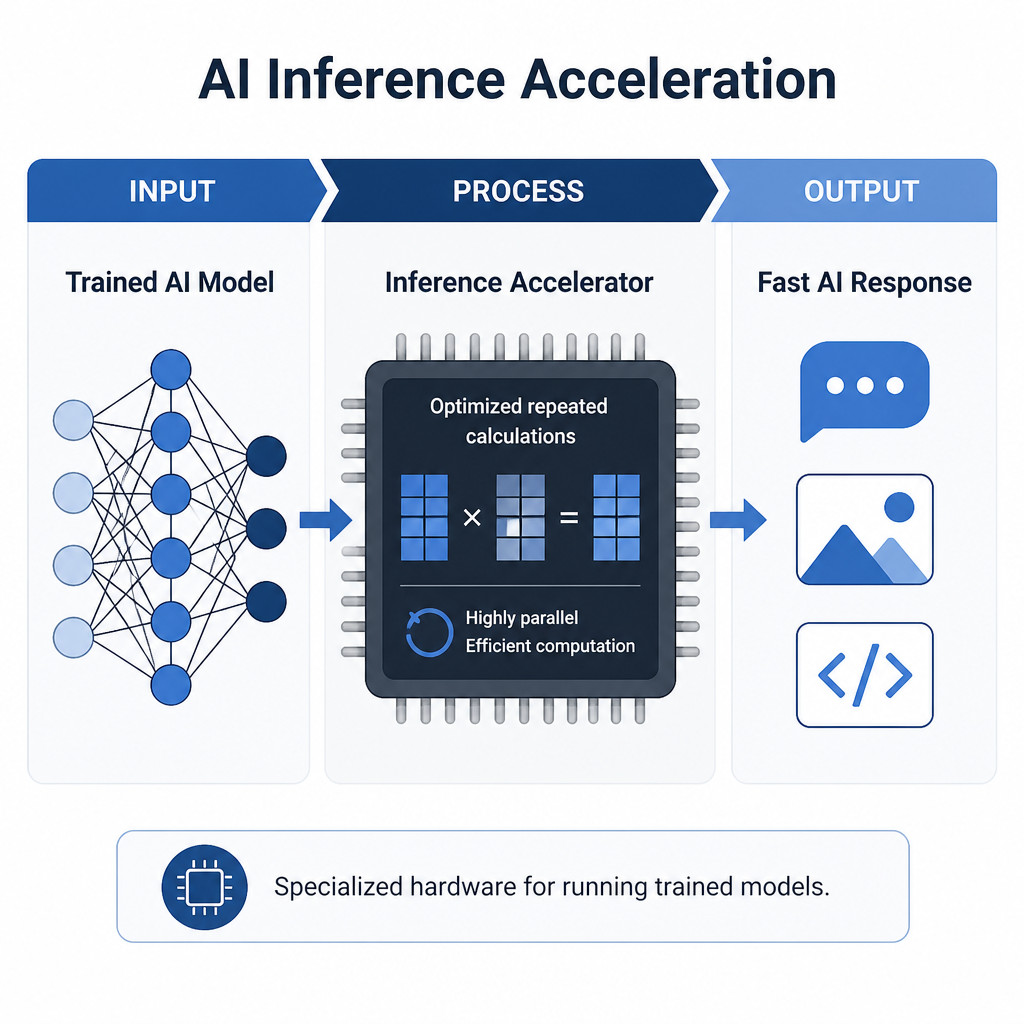
It’s different from AI training, the far more computationally intensive process of adjusting a model using huge datasets. A general-purpose GPU can handle both tasks, but an inference accelerator is optimized to serve models repeatedly and efficiently in production.
How Does It Work?
Neural networks rely heavily on matrix multiplication. Large batches of numbers are multiplied and combined to turn tokens, pixels, or audio into predictions. Inference chips arrange their circuitry, memory, and data movement around those repeated calculations.
Because the hardware is tailored to a narrower range of workloads, it can cut down on wasted work compared with a general-purpose processor. Some accelerators are application-specific integrated circuits, or ASICs, with silicon designed for a particular class of AI operations. Google’s Tensor Processing Units, for instance, are custom ASICs for machine-learning workloads.
Why Does It Matter?
For an AI service handling millions of requests, the cost of producing each response matters just as much as the model’s raw capability. Faster inference can reduce delays for users, while better efficiency can lower data-center power use and operating costs. It may also allow companies to deploy more AI features without depending on the same limited pool of high-end GPUs.
Where Is It Used?
Inference accelerators can run large language models, coding assistants, search systems, recommendation engines, speech services, image tools, and AI agents. They’re usually found in cloud data centers, though smaller versions may increasingly appear in devices that need to run AI locally. These chips won’t replace every GPU, but they’re becoming an important part of the infrastructure that turns trained models into usable products.