
Do not assume that a smart plug is safe for a space heater simply because the wattage numbers appear to match. Use one only when the heater manufacturer permits external switching, the documentation for that exact smart-plug model supports the heater’s load and intended use, and the outlet and circuit are suitable. If any of those answers is unclear, do not automate the heater.
Portable heaters are high-power appliances that can run for long periods. Their instructions may prohibit using an external timer, remote switch, extension lead, or other accessory. Those instructions take priority over a smart plug’s headline rating. A plug that can switch a certain maximum load does not change how the heater was designed to be operated.
There is also a basic connection rule: the heater should be connected to a wall outlet, not an extension cord or power strip. The U.S. Consumer Product Safety Commission gives this guidance for portable electric space heaters and advises keeping them away from combustible materials. A smart plug placed directly in a suitable wall receptacle is not the same as a power strip, but it still adds a device whose compatibility and condition must be evaluated. CPSC space-heater safety guidance
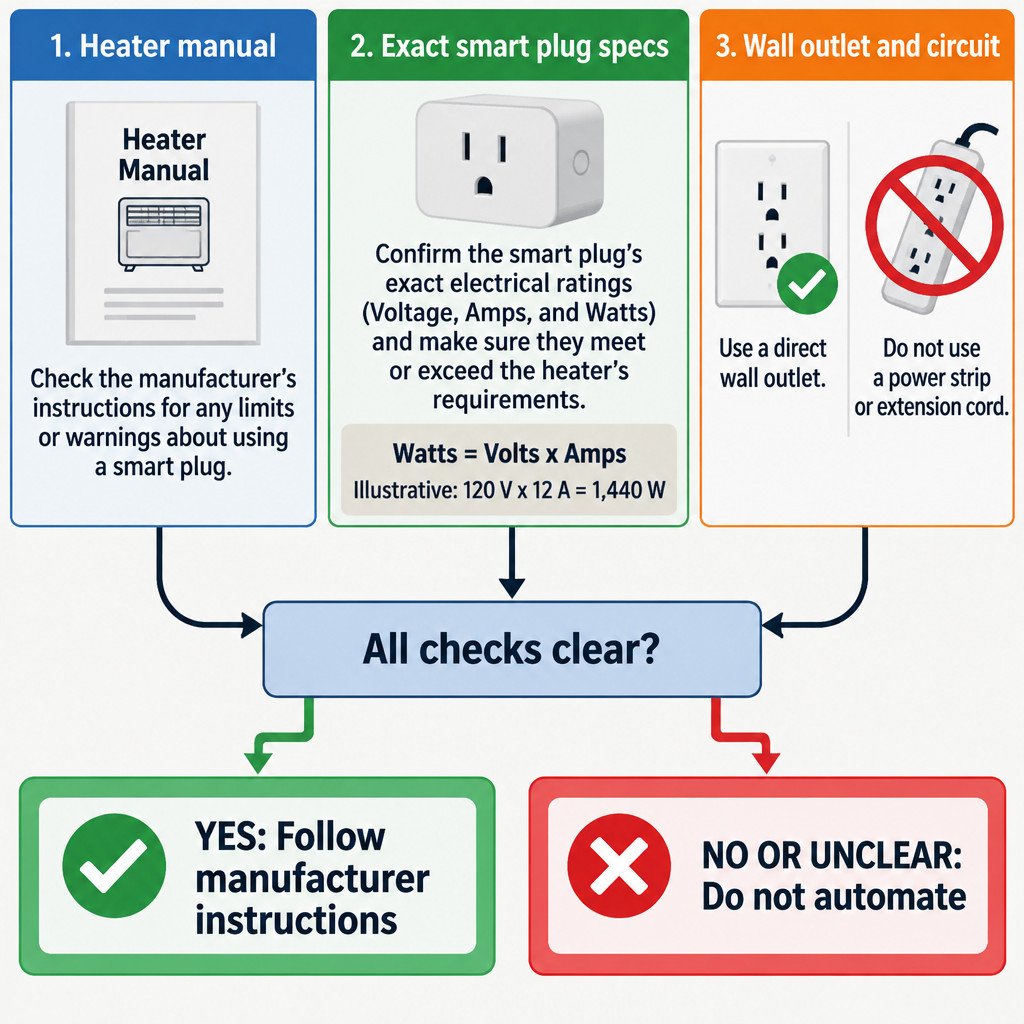
Make three checks before connecting anything
- Heater: Read its label and manual. Look for its voltage, wattage or amperage, and any ban on timers, remote controls, smart outlets, extension cords, or power strips.
- Smart plug: Find the documentation for the precise model and regional version, not a similar-looking product. Confirm its maximum load, voltage, supported load type, and any duration or appliance restrictions.
- Outlet and circuit: Use a sound, appropriately rated wall receptacle. Do not stack adapters, power strips, or extension cords. Consider what else shares that circuit.
A “yes” requires all three checks. One missing manual, an ambiguous specification, a damaged plug or cord, or a restriction from either manufacturer is a “no.”
How to compare volts, amps, and watts
For a simple electrical load, the relationship is:
Watts = volts × amps
- Watts (W) measure power.
- Volts (V) describe the supply voltage.
- Amps (A) measure current.
For example, using 120 V and 12 A gives 120 V × 12 A = 1,440 W. This is an illustrative calculation, not a safe-use recommendation for a particular heater or plug. It only helps translate one rating into another when the stated voltage is the same.
Compare the ratings on the same basis. A 120 V plug specification should not be treated as interchangeable with a product intended for another voltage. Also, treat “maximum” as a boundary rather than a target for a long, unattended run. The plug manufacturer may impose a lower limit for a particular appliance category or advise against continuous operation at full load.
Why a matching wattage is not enough
Smart plugs are not all designed for the same electrical loads. Manufacturer guidance for Tapo and Kasa plugs, for example, says the products are primarily designed for resistive loads and calls for caution with high-power motor-driven appliances because of inrush current. It also says to check the individual product’s maximum load and supported load types, and not to operate at full load for extended periods. That guidance is specific to those products, but it illustrates why a single wattage comparison is incomplete. TP-Link load compatibility guidance
Product specifications can include limits beyond watts. As one example of model-specific documentation, TP-Link lists the Kasa EP25P4 at 15 A and 1.8 kW at 120 V, with a 1/6 HP motor rating, and warns that erratic currents can damage the plug and surrounding area even when the listed maximum is not exceeded. This is not approval to use that plug with any heater; it is a reason to read the exact documentation rather than rely on a generic “15 A smart plug” description. EP25P4 product specifications
Check how the heater behaves after power is restored
A smart plug cuts and restores power; it does not operate the heater’s controls in the way its own buttons or thermostat do. Some heaters may remain off after a power interruption, while others may resume a previous setting. Do not guess. Check the heater manual for its behavior and for any prohibition on external controls. Never use a smart plug to defeat a heater’s safety features or to make an appliance restart in a way its maker does not allow.
A practical go-or-no-go checklist
| Question | What to do |
|---|---|
| Does the heater manual permit external switching or the proposed arrangement? | If no or unclear, do not use the smart plug. |
| Does the exact plug documentation support the relevant load type and rating? | If no or unclear, do not use it. |
| Are voltage, amps, and watts within the plug’s stated limits? | Proceed only if all applicable ratings are within limits; this alone is not sufficient. |
| Is the plug connected directly to a suitable wall outlet? | Do not add an extension cord, power strip, adapter stack, or another smart plug. |
| Are the heater cord, plug, smart plug, and outlet undamaged? | Stop and replace or have the issue assessed before use. |
| Will the heater operate without close supervision? | Follow the heater maker’s instructions; do not treat scheduling as a substitute for safe placement and use. |
Use safe placement and simple connections
Keep the heater, its cord, and the smart plug visible and accessible. Do not run the cord where it can be pinched, covered, trapped under furniture, or damaged. Keep combustible materials away from the heater as its instructions require. If a plug, outlet, or cord feels hot, shows discoloration, fits loosely, or is otherwise damaged, stop using it and address the problem rather than trying another adapter.
Pay attention to the circuit, too. A heater can represent a substantial share of a circuit’s available capacity, and other appliances on the same circuit still draw power. Repeated tripping, flickering, a warm outlet, or an uncertain wiring arrangement are not problems to solve with a higher-rated plug. Consult a qualified electrician when the outlet or circuit is in doubt.
Choose automation that does not add uncertainty
For a heater, its built-in thermostat, timer, and controls are the safer default when supplied by the manufacturer. If remote scheduling is important, consider a heater specifically designed with manufacturer-provided controls rather than adding a third-party switching device.
Smart plugs are often better reserved for compatible, lower-risk loads such as lamps, subject to each product’s instructions and ratings. Automation is useful only when it preserves the appliance maker’s operating limits. With space heaters, a conservative decision is the right one: if the documentation does not clearly support the setup, leave the smart plug out.
Sources
- U.S. Consumer Product Safety Commission: portable space-heater safety guidance.
- TP-Link: load compatibility guidance for Tapo and Kasa plugs.
- TP-Link: EP25P4 model specifications.
