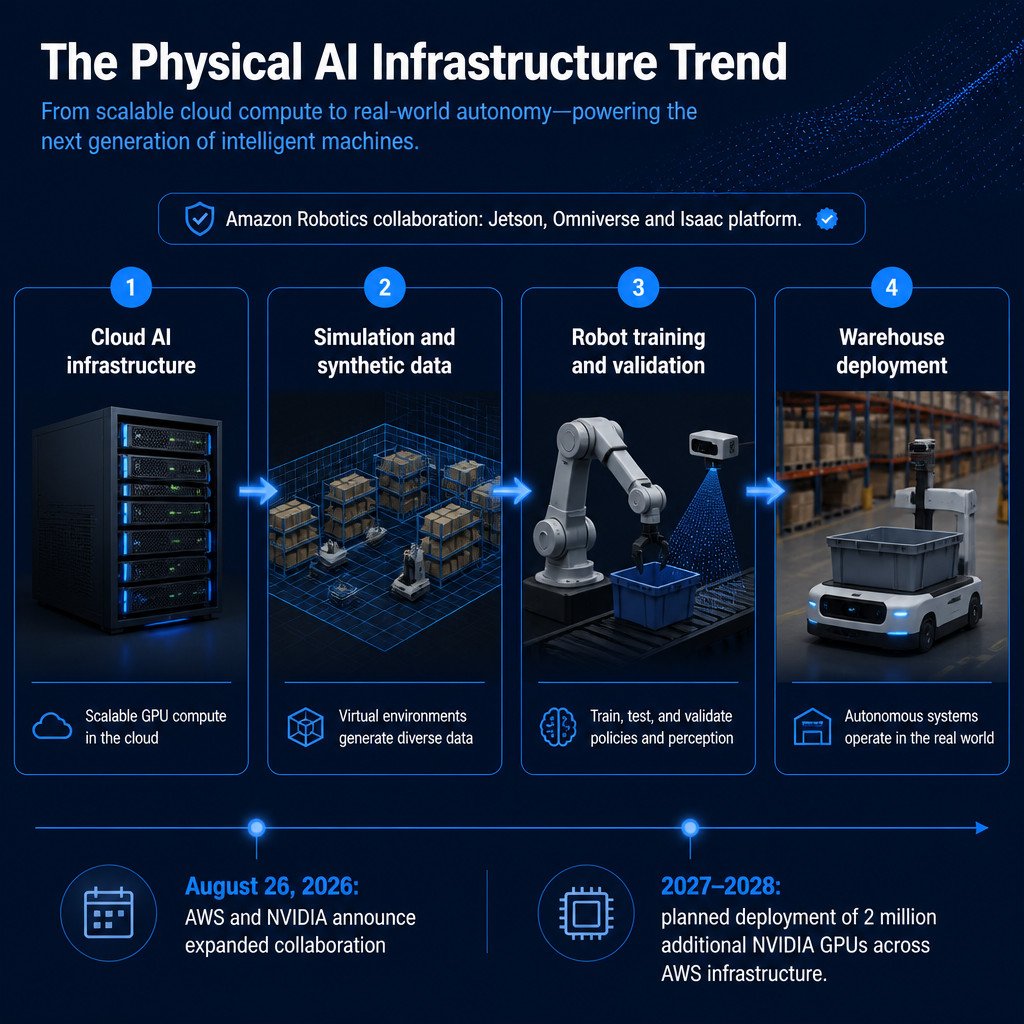
The latest AI infrastructure news reaches well beyond chatbots. On August 26, AWS and Nvidia announced plans to deploy 2 million additional Nvidia GPUs across AWS global infrastructure in 2027 and 2028. What stands out is what the companies placed alongside that figure: robotics and “physical AI.”
The announcement marks a fast-growing technology trend. Cloud platforms are no longer presenting AI compute simply as a place to train models and run queries. Increasingly, they’re becoming development environments for machines that must see, move and work in the real world.
A full-stack push into robotics
In their August 26 announcement, AWS and Nvidia said the expanded partnership would cover GPUs, CPUs, networking, open models, data processing and robotics. Amazon Robotics is also expected to work with Nvidia’s physical-AI stack, including Jetson edge computing, Omniverse libraries and the Isaac robotics development platform.
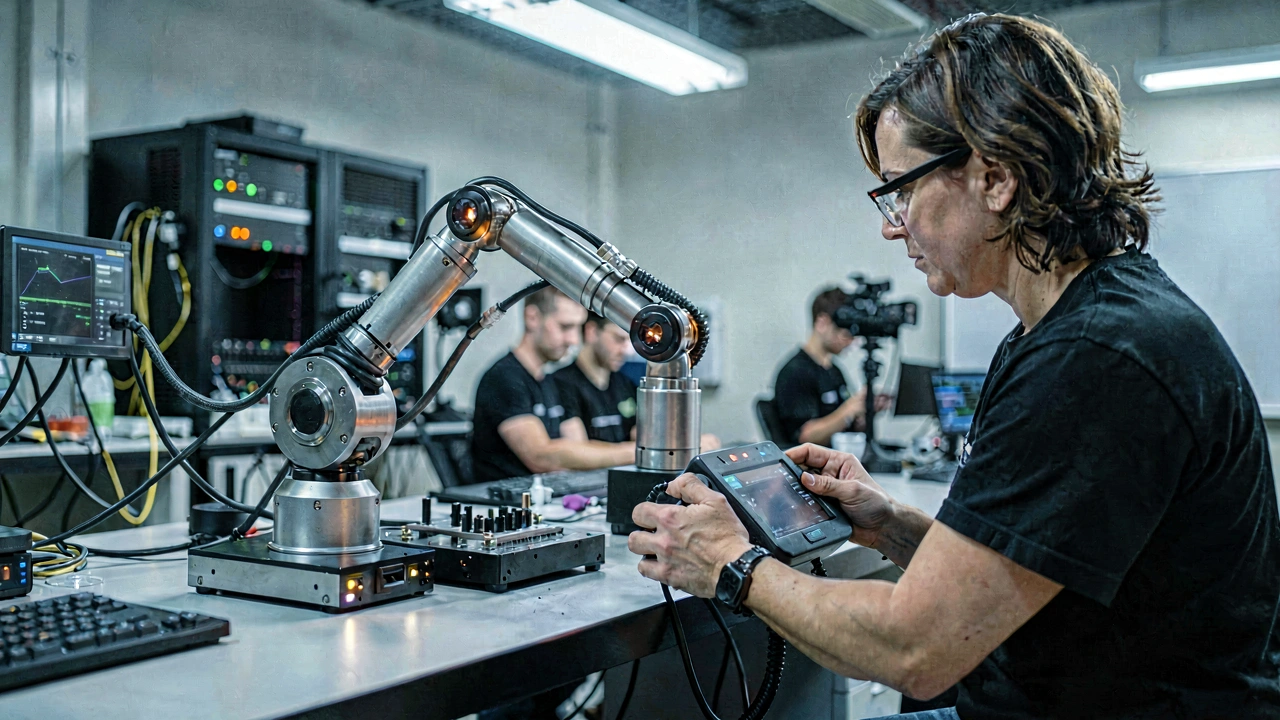
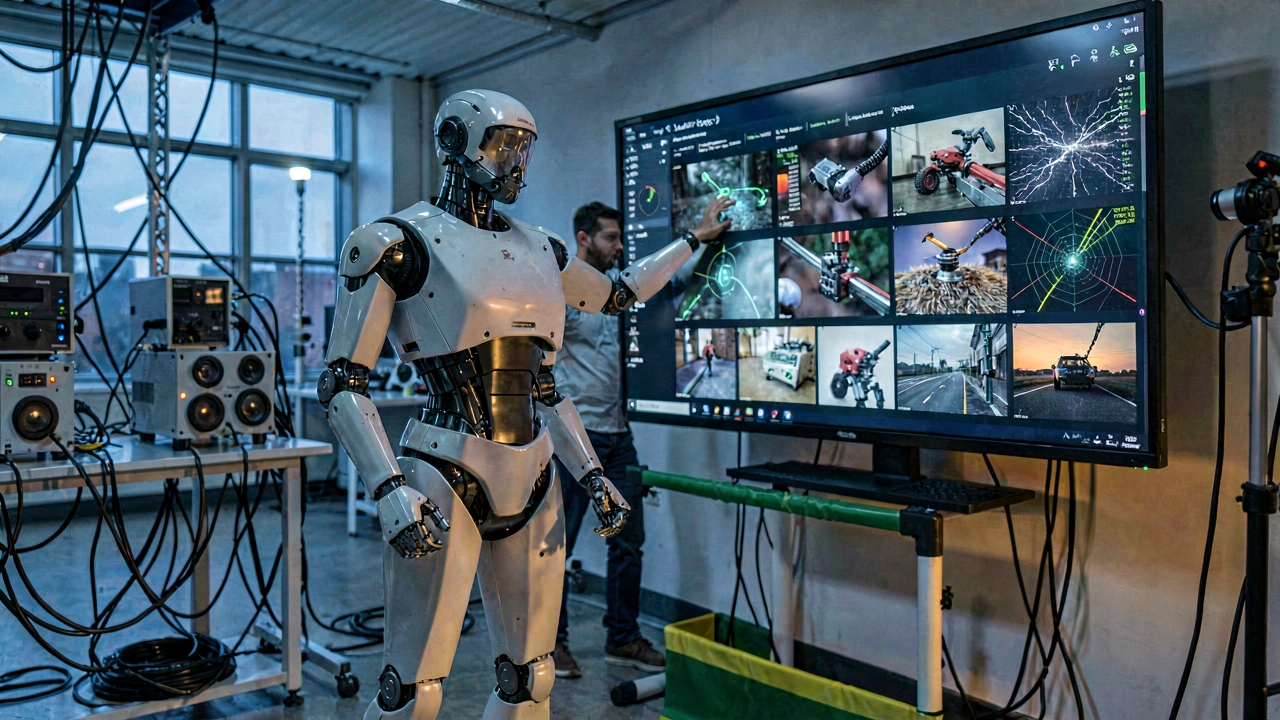
Those details matter because a useful robot needs far more than a capable machine-learning model. Developers have to build and test software in simulation, generate or process large training datasets, check behavior against real-world conditions and then run the finished system reliably on a robot. Doing all of that requires both cloud-scale computing and edge hardware capable of making rapid decisions.
Why physical AI is gaining attention
AI’s first consumer wave was mostly screen-based: enter a prompt, receive text, create an image or summarize a document. Physical AI takes on a harder challenge by connecting perception with action. That could mean warehouse equipment that finds its way around changing obstacles, robotic arms that handle different objects, or industrial systems that improve through repeated simulation and real-world feedback.
The announcement doesn’t mean warehouses will become fully autonomous overnight. AWS and Nvidia’s plans are forward-looking, and deploying robots in messy, safety-critical workplaces is much harder than rolling out a digital assistant. Robots must deal with imperfect sensors, unpredictable people, unusual objects and errors that can be costly.
Still, the investment signal is clear. The industry increasingly treats simulation, training data, high-speed networking and on-robot inference as connected parts of a single product stack. That’s a meaningful shift from the older model, in which robot makers assembled much of the tooling themselves while cloud providers mainly supplied generic compute.
What to watch next
The main question isn’t whether a humanoid robot can deliver an impressive demonstration. It’s whether companies can cut the time and cost involved in teaching robots practical tasks, testing them safely and updating them after deployment. If cloud providers make those steps easier, physical AI could spread first in structured commercial settings such as fulfillment centers, factories and logistics sites.
For now, the biggest trend is less flashy than a robot appearing onstage. The cloud is being redesigned as the workshop where future robots are trained before they enter the real world.