The next major contest in humanoid robotics may have little to do with producing the most convincing robot video. Instead, it could come down to finding the right few seconds of data after a robot makes a mistake.
That shift became clearer on August 18, when robotics software company Foxglove announced Semantic Search. The tool allows engineering teams to search recorded robot camera and video data using plain-language prompts. Rather than combing through timelines or depending entirely on pre-written labels, developers can describe the scene or action they need to investigate.
The launch coincided with Actuate 26, Foxglove’s San Francisco conference for physical-AI developers, held August 18–19. It’s a small but telling sign. As robots become better at moving, the less glamorous work of finding, testing and learning from edge cases is taking a central role in the race.
Robotics has a retrieval problem
Robots can gather enormous amounts of data from cameras and other sensors. Yet the most useful material is often the hardest to find: a box slipping from a grip, a worker entering the frame, a machine facing a reflective surface, or an autonomous vehicle misreading an unusual road situation.
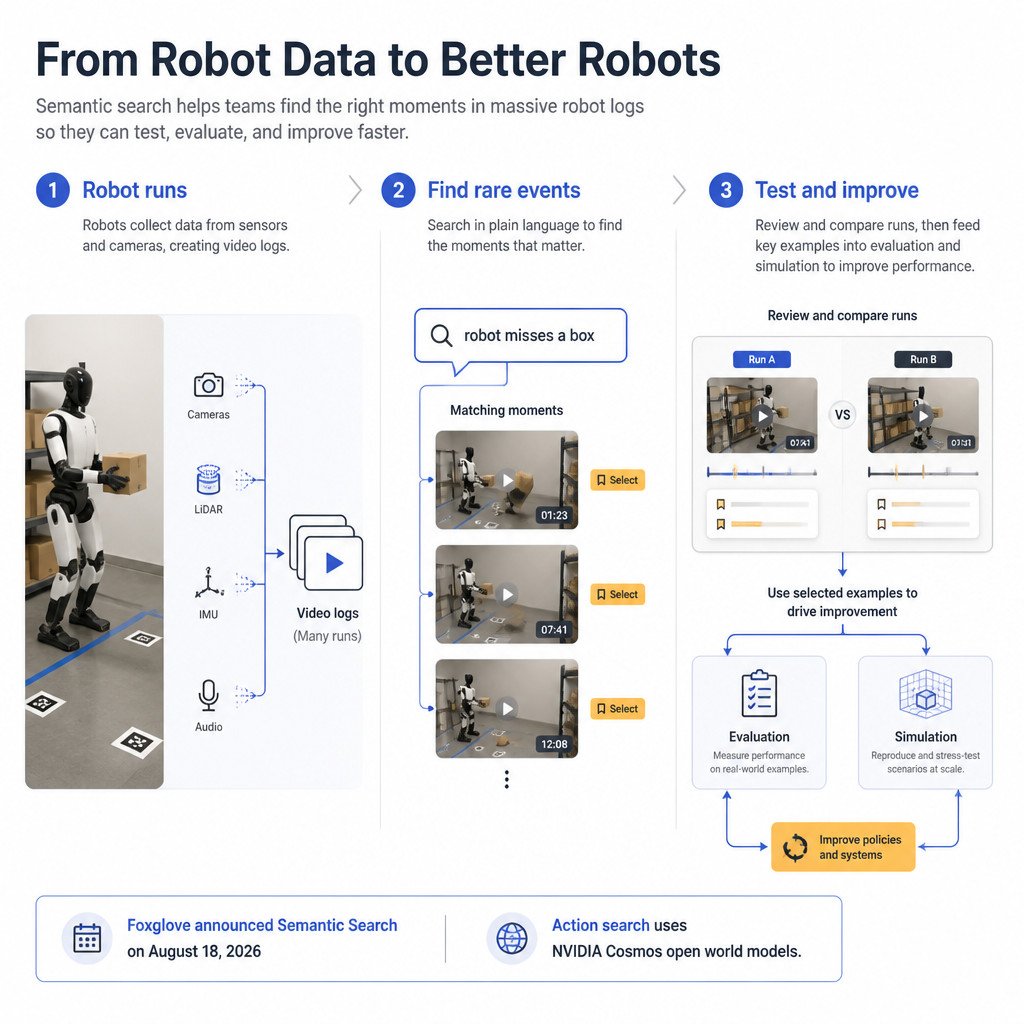
Those moments are difficult to locate because teams can’t label every surprise before it occurs. Foxglove says its new system processes image and video topics as data is ingested. Its action search uses NVIDIA Cosmos open world models to identify motion and events across sequences of frames.
This matters because physical AI can’t improve solely by absorbing generic internet text. A robot has to connect perception with movement in environments that are messy and constantly changing. The quality of its training examples and evaluations may be just as significant as the sophistication of the model itself.
Why the trend is growing now
Humanoid and industrial-robot demonstrations have become increasingly polished. Meanwhile, more companies are trying to move machines beyond controlled showcases and into warehouses, factories, roads and outdoor worksites.
The difficult question is no longer just whether a robot can complete a task once. Teams need to know if it can repeat that task safely and recover when conditions change.
That need is creating demand for tools that help engineers compare runs, isolate failures and create targeted simulations. Foxglove’s broader August 18 release also introduced a built-in agent for working with data, along with a comparison mode for reviewing multiple recordings or events on a single timeline.
Robot reliability moves to the foreground
In practice, robotics companies may increasingly compete through their data operations: how quickly they can capture failures, retrieve relevant examples, test an update and confirm that it hasn’t caused a new problem.
Consumers probably won’t see that infrastructure directly. They’ll notice the results, though. A household robot, delivery machine or warehouse humanoid becomes genuinely useful only when it remains dependable during the boring moments as well as the impressive ones.
Semantic search won’t solve the wider data challenge on its own. The system still depends on the recordings a company has collected, and engineers must check any results produced by a natural-language search. Even so, its arrival points to where physical AI is heading: away from one-off stunts and toward the systems that help robots learn from reality.