MetaRoCE is a network transport for the massive Ethernet fabrics that link GPUs in AI data centers. It drew fresh attention after Meta announced it on August 24, 2026, presenting it as an open design for AI-scale infrastructure. The name combines Meta with RoCE, or Remote Direct Memory Access over Converged Ethernet.
What MetaRoCE is
MetaRoCE is an RDMA transport. RDMA allows one machine to write data directly into another machine’s memory with minimal CPU involvement. That’s important when thousands of GPUs are continually exchanging model weights, calculations, and training results.
Traditional RoCE systems typically assume packets will arrive in order and depend on network controls designed to prevent packet loss. MetaRoCE goes another way. It’s designed to run over ordinary, potentially lossy Ethernet, treating out-of-order packets as a normal part of operation rather than an exception.
How MetaRoCE works
Rather than keeping every packet on a single route, MetaRoCE can distribute packets from one connection across several network paths. That can help in large data centers, where individual routes may become congested or fail.
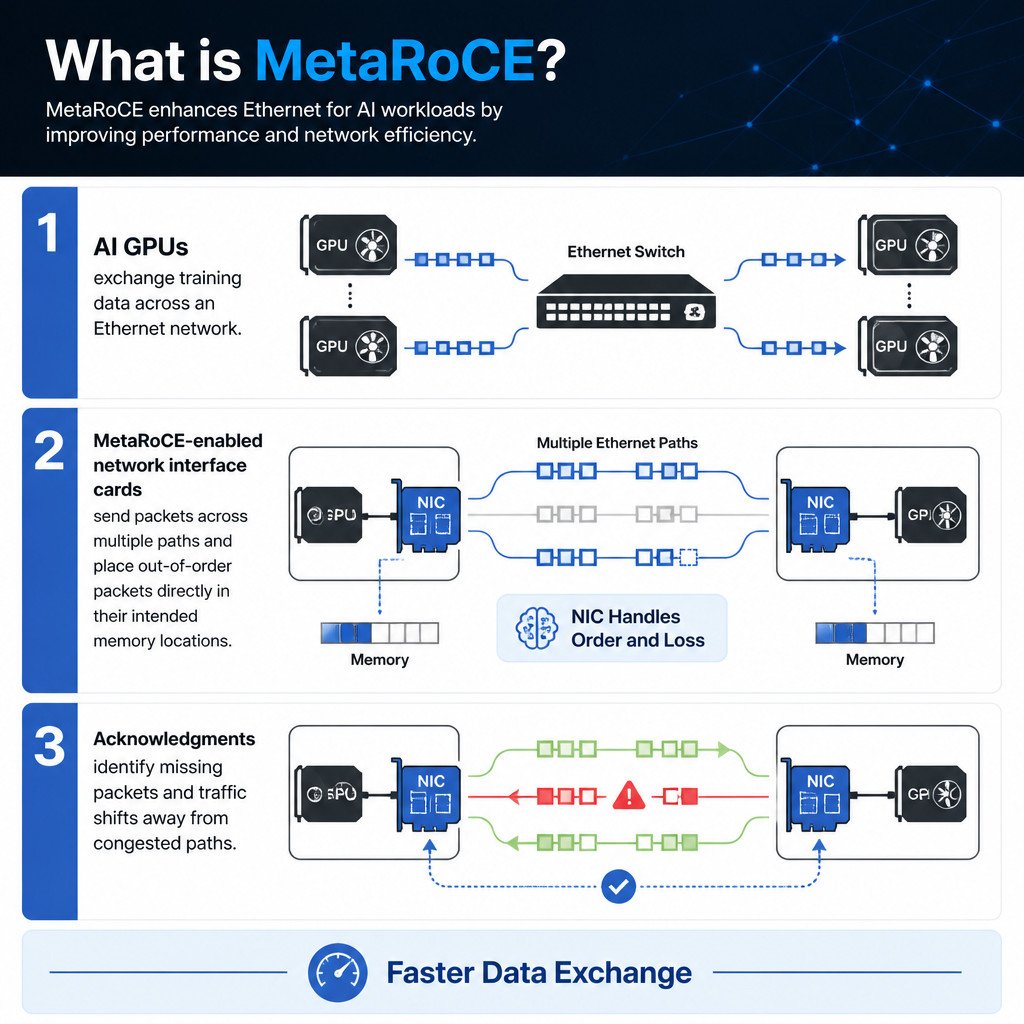
Each packet carries enough destination information for the receiving network interface card, or NIC, to write it directly to the right location in memory. The NIC doesn’t have to keep later packets in a reorder buffer while it waits for an earlier one. When a packet is missing, acknowledgments identify the gap so it can be retransmitted. MetaRoCE also monitors congestion separately on individual paths, allowing traffic to shift away from a busy route.
Why it matters
Modern AI training is often constrained by communication among accelerators, not just chip speed. Operations such as all-reduce require large numbers of GPUs to synchronize, and one delayed transfer can hold up the broader job.
By reducing head-of-line blocking and removing the need for lossless Ethernet controls such as priority flow control, MetaRoCE aims to make very large GPU networks more resilient and easier to operate. Meta says the design works with standard Ethernet features, including ECMP routing and ECN congestion marking.
Why people are talking about it now
Meta’s August announcement gave a name to a growing AI infrastructure problem: moving huge amounts of data between distributed accelerators. Meta plans to contribute the specification, reference software, and compliance tools through the Open Compute Project. That could make the approach relevant to NIC makers and operators building large Ethernet-based AI clusters.