UnifiedBus, usually called UB, is a Huawei-developed interconnect architecture built to connect large numbers of computing components for AI workloads. It has drawn more attention following Huawei Connect 2026, where the company introduced new UnifiedBus-based systems and positioned it as a central part of its Peerium computing architecture.
What UnifiedBus Is
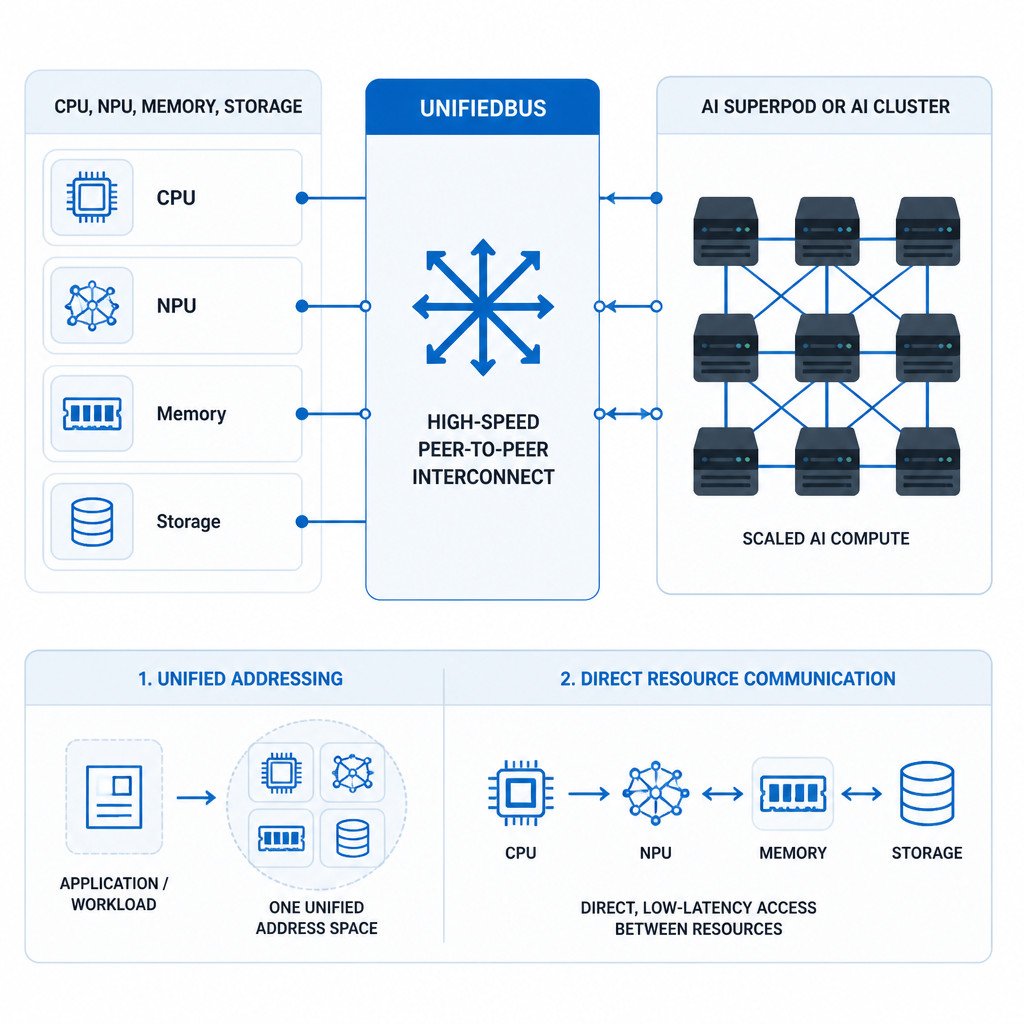
An interconnect is the technology that allows processors, memory, storage and networking hardware to exchange data. UnifiedBus is aimed at AI “SuperPods” and clusters, which bring together large groups of servers and accelerators to handle a single task, such as training or running a large language model.
Instead of treating each machine as a mostly separate unit joined only by conventional networking, UnifiedBus is meant to make distributed hardware work more like parts of one much larger computer. Huawei describes it as a single protocol that can connect CPUs, NPUs (AI accelerators), memory, SSDs, network cards and switches.
How UnifiedBus Works
AI systems are constantly moving model parameters, intermediate calculations and data between accelerators and memory. As clusters get bigger, that communication can become a bottleneck. UnifiedBus uses peer-to-peer communication, unified addressing and memory-oriented operations to cut down on the software and protocol steps needed to share resources.
The goal is for a processor to access resources elsewhere in the system in a way that more closely resembles reaching locally attached memory. Physical links, switches and adapters still play a role, but the protocol sets common rules for how connected components discover one another, address resources and exchange data.
Why It Matters
Adding more chips doesn’t automatically make an AI system faster. Those chips need to exchange data quickly and reliably enough to remain busy. A faster, better-coordinated interconnect can improve scaling, letting a cluster take on workloads that exceed the memory or compute capacity of a single server.
UnifiedBus isn’t intended to replace Ethernet in everyday offices or homes. It is aimed at high-performance AI infrastructure, where communication latency, bandwidth and system coordination can strongly affect results. Its renewed visibility in September 2026 reflects the wider industry focus on the connections between AI chips, rather than the chips alone.