As AI models get larger, data centers need more than powerful individual chips. Those chips also have to communicate at extremely high speeds. That’s the problem UALink is designed to solve. The technology has attracted fresh attention after the UALink Consortium discussed accelerator-interconnect advances at the Future of Memory and Storage conference, held August 4–6, 2026.
What Is UALink?
UALink, short for Ultra Accelerator Link, is an open industry standard for connecting AI accelerators, such as GPUs, with the switches that link them inside an AI computing pod. A pod is a tightly connected group of servers built to handle one large AI workload rather than many unrelated tasks.
It’s a scale-up interconnect, meaning it helps a group of nearby accelerators operate more like components of one larger system. Scale-out networking works differently, connecting separate servers or racks across a wider data-center network.
How UALink Works
Training and running large AI models requires a constant flow of model parameters, calculations, and memory data between accelerators. When those exchanges are slow, expensive processors can end up waiting instead of calculating.
UALink defines the protocols and physical connections that allow accelerators and switches to exchange data with high bandwidth and low latency. It supports memory-style operations, including direct reads, writes, and atomic operations. Atomic operations are coordinated updates used when several processors are working on related data.
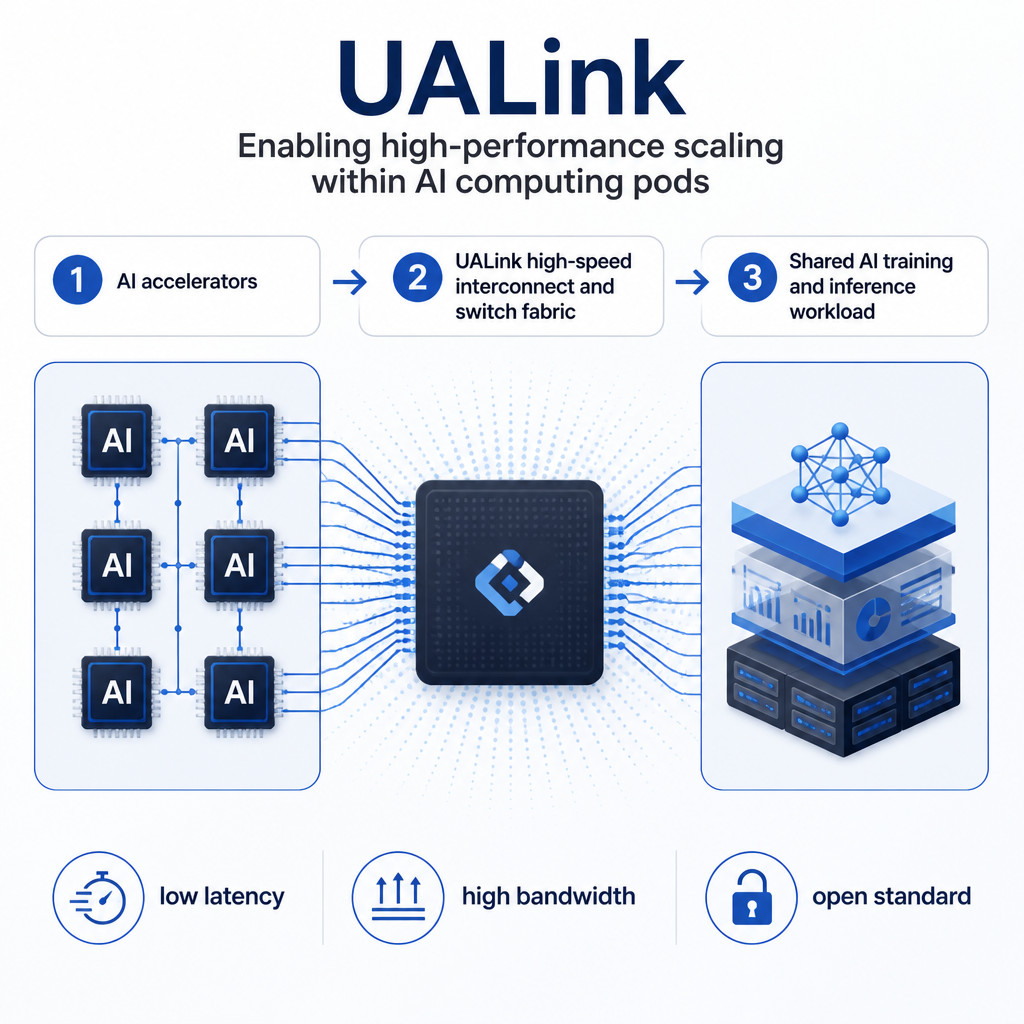
The aim is to reduce communication bottlenecks while allowing software to work more directly with remote accelerator memory.
Why UALink Matters
AI performance increasingly depends on the connections between chips, not just the chips themselves. A fast, standardized link can help system builders create larger clusters for AI training and inference without depending entirely on a single vendor’s proprietary fabric.
The UALink 200G 1.0 specification describes connections for up to 1,024 accelerators within a pod. As an open standard, it could provide chip makers, server vendors, and cloud operators with a shared foundation for interoperable AI infrastructure. UALink won’t make an individual GPU smarter, but it can help many accelerators work together more efficiently on workloads too large for one chip.