For years, foldable phones have tried to prove they’re more than costly experiments. On September 9, 2026, Apple gave the category its biggest mainstream test yet with the iPhone Duo, its first foldable iPhone.
The bigger story isn’t merely that Apple has made a folding device. Foldables are becoming a platform battle spanning hardware, operating systems, app design, cameras, batteries, and artificial intelligence.
Apple changes the foldable conversation
According to Apple’s announcement, the iPhone Duo opens into a 7.6-inch inner display and folds down to a 5.4-inch outer screen. It has a titanium body, a precision hinge, a dual-battery design, and Apple’s A20 Pro chip.
The specs matter, of course. But Apple’s broader pitch is familiar software adapted to a new shape. iOS 27 has been redesigned for the folding format, with Split View multitasking, two-window support, adaptable app layouts, and new options for using the camera when the phone is partly or fully open.
That could address a long-running problem with many foldables: impressive hardware paired with software that still feels like a standard phone interface stretched across a larger screen.
Foldables are becoming an ecosystem product
Apple says third-party apps including Netflix, Zoom, and Slack are already being adapted for the Duo’s larger display. How those apps perform will matter more than hinge details or screen measurements. A foldable is useful only if developers treat it as its own kind of device, rather than an oversized phone.
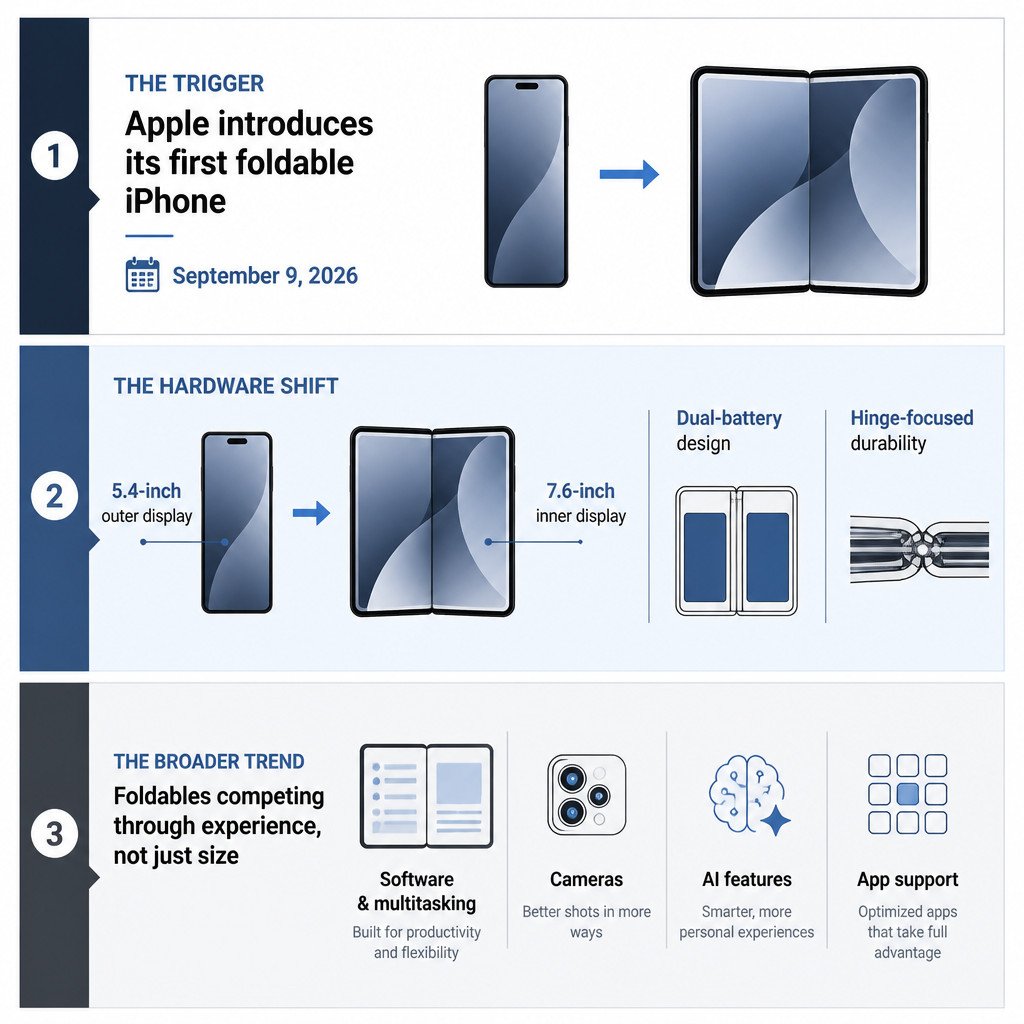
Apple is also tying the new form factor to its current AI strategy. The iPhone Duo will support Apple Intelligence and the beta version of Siri AI, including on-screen awareness and personal-context features. It offers a practical test for AI on larger mobile displays. Can an assistant work alongside documents, messages, websites, and video calls instead of sitting in a small chat window?
Why it matters to buyers
The iPhone Duo starts at $1,999 in the United States. Pre-orders begin October 16, and the phone will be available from October 23, 2026. That keeps it firmly in premium territory, though Apple’s entry could still shape the wider market.
Phone makers now have to compete on more than thinness and screen size. They’ll be judged on durability, battery life, software support, camera flexibility, repairability, and whether the folded and unfolded modes feel like one coherent product.
The next stage of the foldable-phone race will be less about proving that folding screens can work. It will be about showing ordinary smartphone users that opening their phone lets them do something meaningfully different.