Co-packaged optics is drawing attention as AI data centers hit a physical networking limit. Moving data among thousands of accelerators demands more bandwidth than conventional electrical connections can deliver efficiently. At the SC26 supercomputing conference in November 2026, NVIDIA highlighted a Lambda deployment using photonics-based co-packaged optics switches. Chip companies, including Marvell, are also showing related designs for larger AI systems.
What Is Co-Packaged Optics?
Co-packaged optics, usually called CPO, is a hardware design that puts optical engines very close to a networking or computing chip within the same package or module. The optical engine turns electrical data signals into pulses of light, which then travel through fiber-optic cables.
With a conventional switch, the main chip sends high-speed electrical signals across a circuit board to removable optical transceivers at the front of the device. As link speeds increase, that distance becomes harder to manage. CPO shortens the electrical part of the path and shifts data into fiber earlier.
How Co-Packaged Optics Works
A switch chip processes and routes data first. Small electrical connections carry it to nearby optical engines, where lasers and photonic components encode the information as light. Fiber cables carry those optical signals to other switches, servers, or AI racks. At the receiving end, another optical receiver converts the light back into electrical signals.
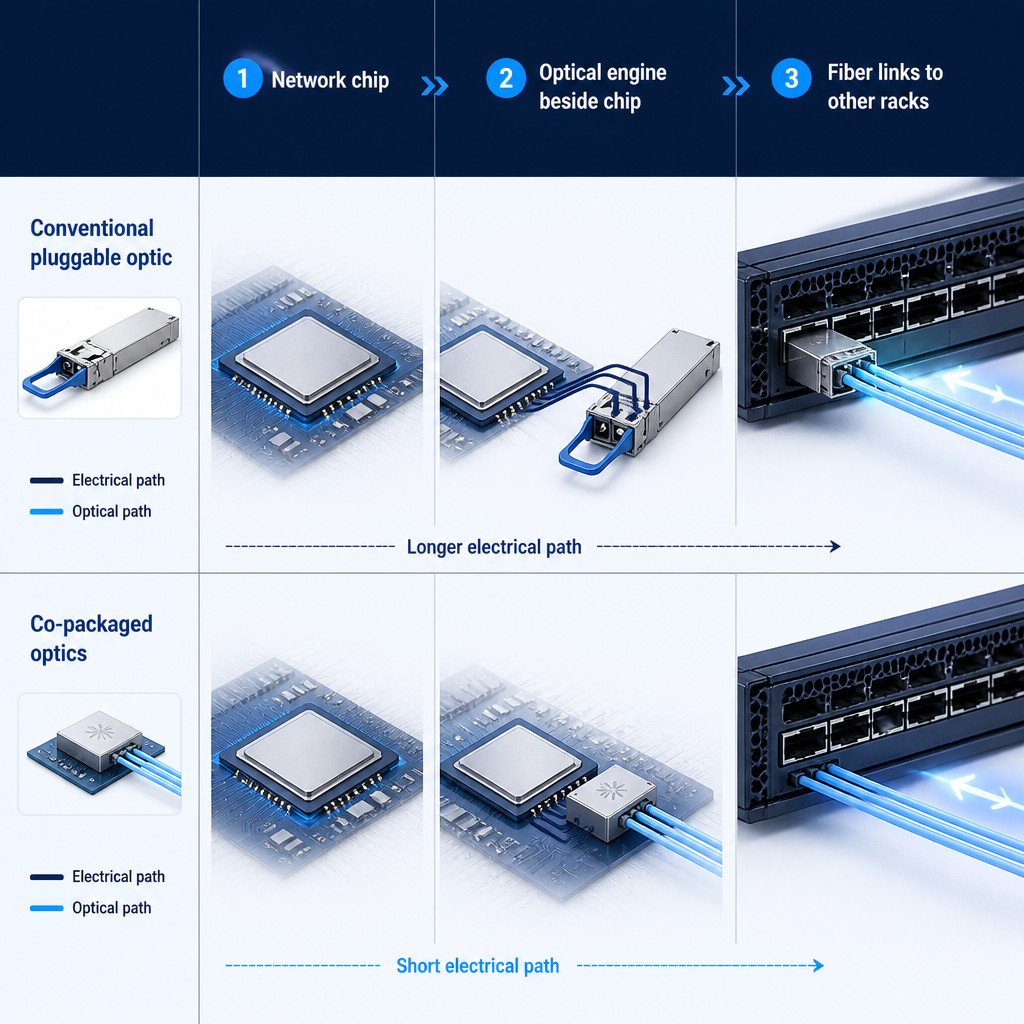
The chip itself doesn’t become entirely optical. CPO instead cuts down the long, power-hungry electrical links between a chip and its optics.
Why It Matters
Large AI training and inference clusters are constantly exchanging model parameters, activations, and results. Networking can become a bottleneck if GPUs or other accelerators are left waiting for data. By reducing how far electrical signals need to travel, co-packaged optics can increase bandwidth density and lower the energy required for very fast connections.
There are practical trade-offs. Front-panel optical modules are built to be replaced one at a time, while optics placed close to a chip are more difficult to service and must meet demanding cooling and manufacturing requirements. So CPO remains an emerging data-center technology, not a standard feature in everyday servers.
Where It Is Used
Its main use is in large-scale AI and high-performance computing infrastructure, where huge numbers of accelerators need fast, reliable links across racks. As AI clusters grow, co-packaged optics may become an important way to keep their networks from taking up too much power and space.