Post-quantum cryptography is moving beyond research circles and into everyday security discussions. It received fresh attention this month when Google introduced the Pixel 11 family with a security chip that supports post-quantum cryptography standards. But the shift goes well beyond a single phone. Companies and governments are preparing to replace some widely used encryption methods before powerful quantum computers can threaten them.
What Is Post-Quantum Cryptography?
Post-quantum cryptography, commonly shortened to PQC, is encryption designed to withstand attacks from both conventional computers and future large-scale quantum computers. Much of today’s public-key security, including systems that establish secure connections and verify identities, depends on mathematical problems such as factoring extremely large numbers. A sufficiently capable quantum computer could solve some of those problems much more efficiently than current machines can.
PQC relies on different mathematical problems that are believed to be difficult for ordinary and quantum computers alike. In 2024, the US National Institute of Standards and Technology, known as NIST, finalized its first major PQC standards.
How Does It Work?
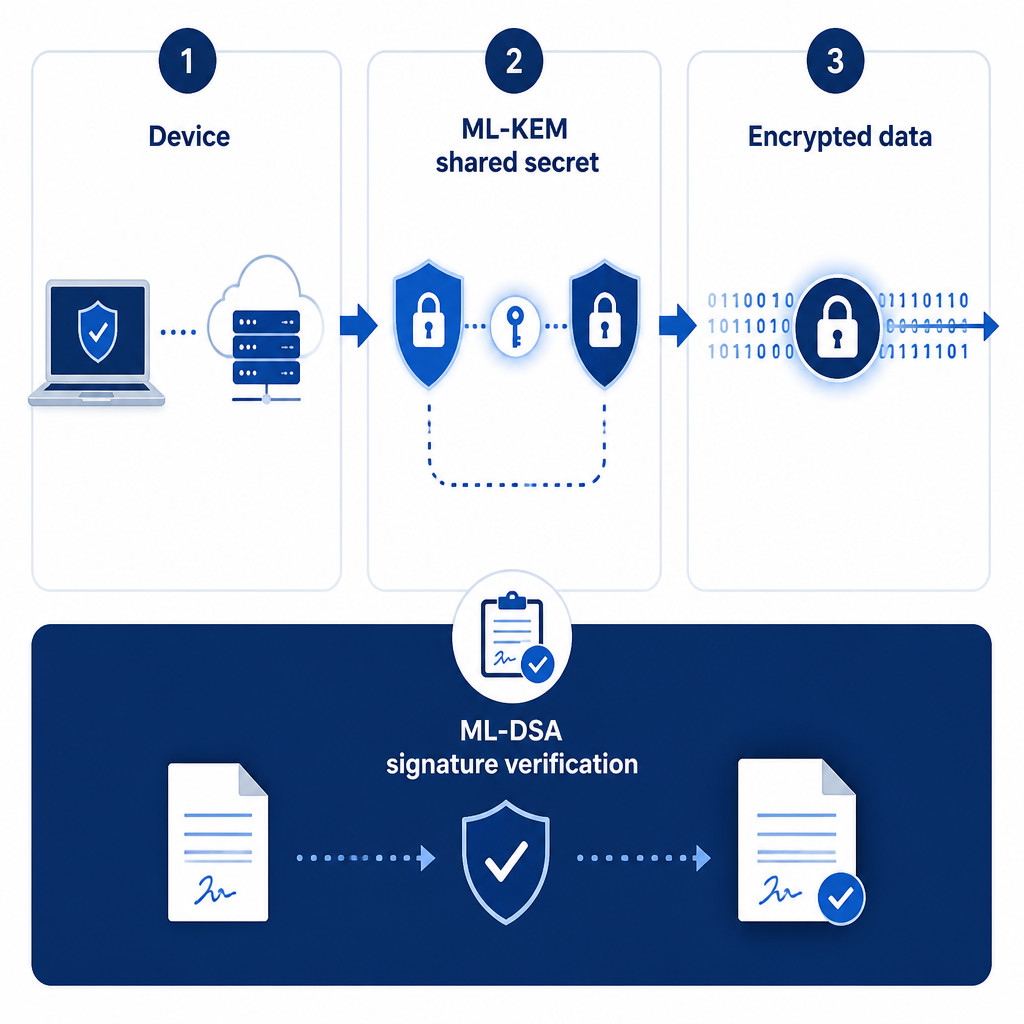
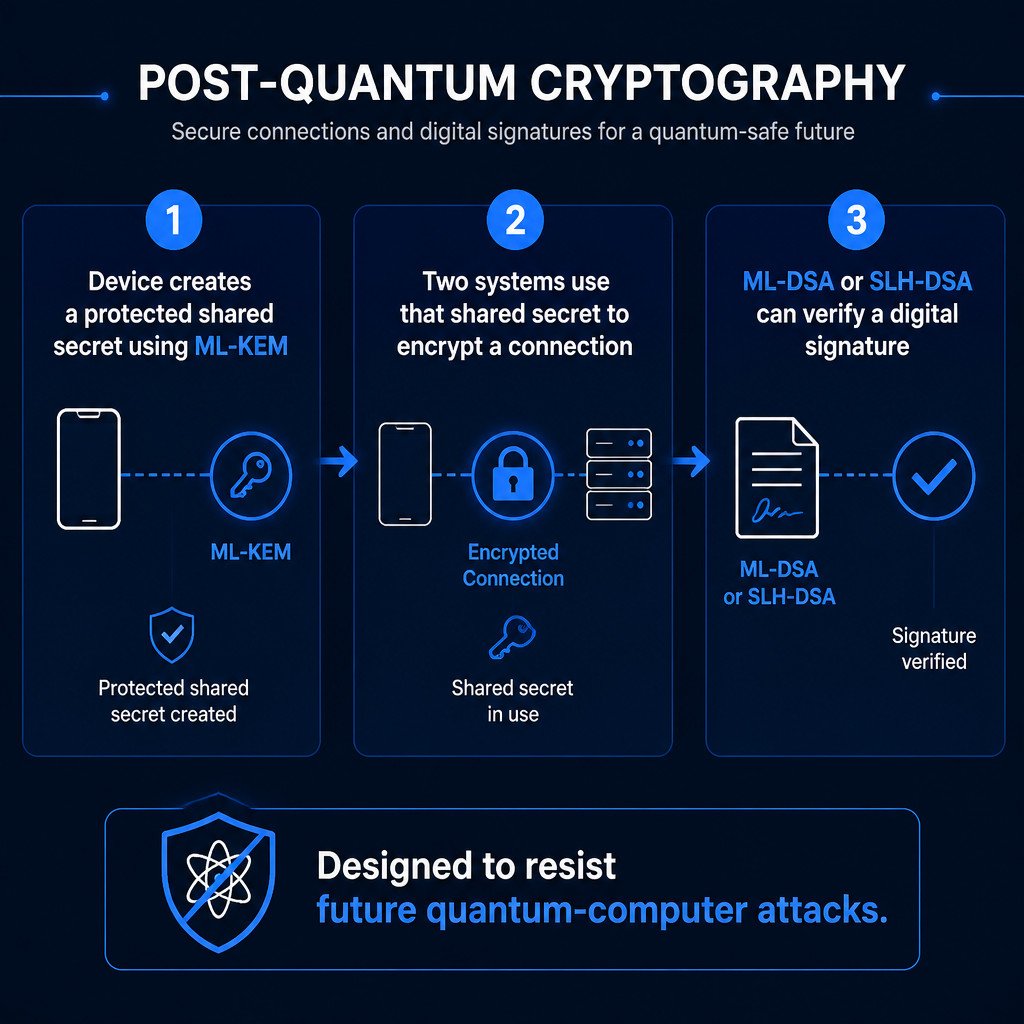
The update covers two main security tasks. A key-encapsulation mechanism allows two systems to create a shared secret over a public network. That secret can then be used to protect an encrypted session. NIST’s primary standard for this job is ML-KEM.
Digital-signature algorithms handle the second task. They confirm that a message, software update, or website identity came from the expected source and hasn’t been altered. NIST standardized ML-DSA and SLH-DSA for digital signatures. Instead of relying on the older public-key mathematics most vulnerable to quantum attacks, these algorithms use methods based on structured lattices or hash functions.
Why Does It Matter?
The danger doesn’t begin only when a practical quantum computer capable of breaking cryptography arrives. Attackers can collect encrypted information today and attempt to decrypt it later, a strategy often called “harvest now, decrypt later.” As a result, data that needs to remain confidential for years may require stronger protection sooner.
PQC will gradually make its way into browsers, cloud services, VPNs, devices, software signing, and government systems. Most people won’t need to switch it on themselves. The transition will instead arrive through security updates, new hardware, and upgraded internet services. Its value lies in preparing the digital trust systems behind banking, private communications, logins, and software updates for a long-term change in computing.