Time-Sensitive Networking, better known as TSN, is drawing new interest as manufacturers develop more AI-assisted robots and connected machines. On October 29, 2026, Microchip added TSN capabilities to its PolarFire FPGA platform for industrial edge applications, underscoring the rising demand for networks that can deliver important data at reliably predictable times.
What Is Time-Sensitive Networking?
TSN is a group of IEEE Ethernet standards intended to make network communication more deterministic. Standard Ethernet typically works on a “best effort” basis. Data usually arrives quickly, though timing can shift when the network is under load. That works well for email, web browsing, and many cloud applications. It’s less appropriate when a robot, motor controller, or safety system needs a command to arrive within a set time window.
By adding timing, scheduling, and reliability features to standard Ethernet, TSN aims to provide bounded latency, low jitter, meaning less variation in arrival times, and low packet loss for traffic that requires those assurances.
How TSN Works
TSN-capable devices begin by synchronizing their clocks, giving them a shared sense of time. Switches on the network can then reserve bandwidth and open or close transmission queues according to a schedule. A time-critical control message gets its own protected slot rather than waiting behind lower-priority traffic, such as video feeds, diagnostics, or software updates.
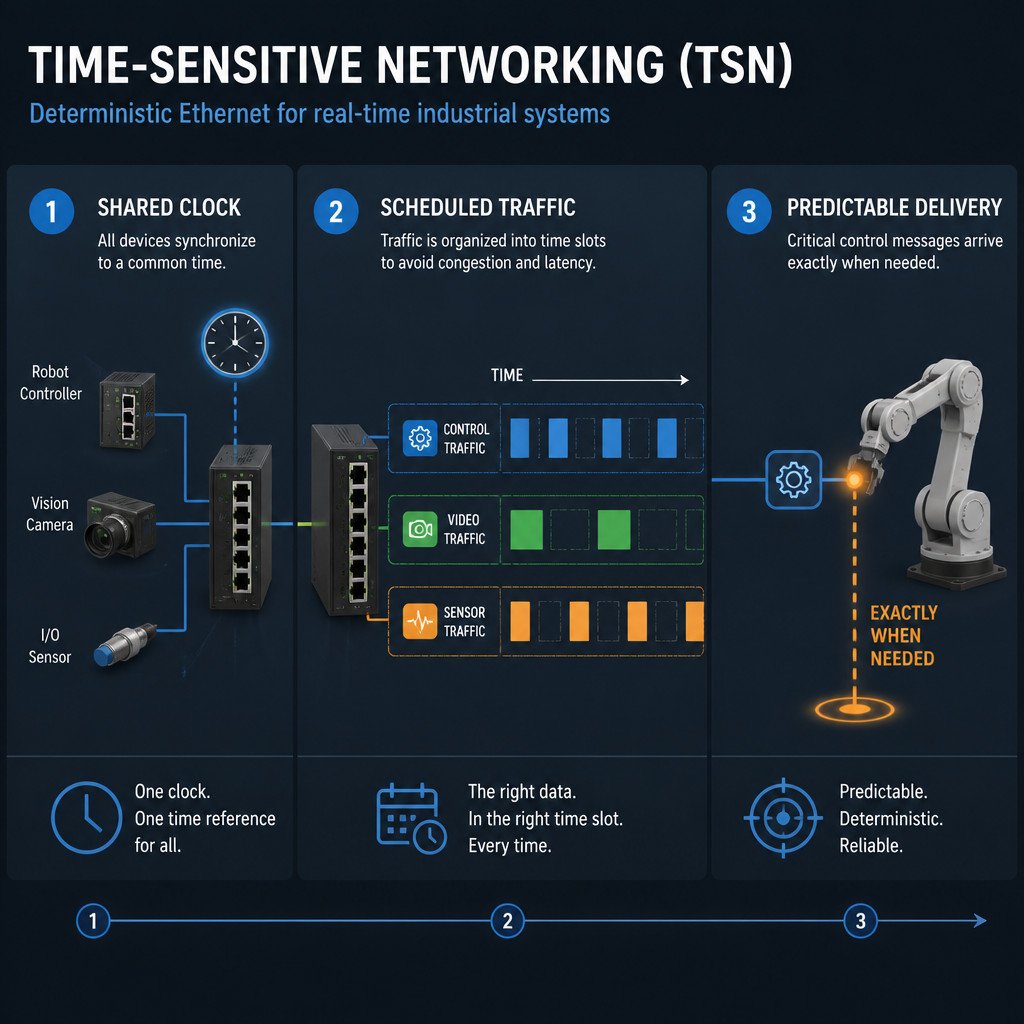
TSN standards can also assign traffic priority, let an urgent frame interrupt a lower-priority transmission, and improve resilience by sending duplicate frames along separate paths in certain designs. Which features are used depends on the application and the equipment involved.
Why It Matters
Today’s machines often combine cameras, sensors, AI inference, motion systems, and remote monitoring on one network. TSN can allow designers to use Ethernet more widely while keeping critical control traffic predictable. That may reduce the need for separate specialized networks within a factory or vehicle.
Where TSN Is Used
TSN is used or being adopted in industrial automation, machine control, collaborative robots, autonomous mobile robots, automotive in-vehicle networks, professional audio and video, aerospace systems, and mobile-network fronthaul. It doesn’t make every Ethernet connection real-time automatically. Compatible devices and switches, along with careful network configuration, are still required. Even so, TSN gives Ethernet a common, standards-based route into applications where timing matters as much as the data itself.