Smart glasses are back in the conversation, though the biggest change isn’t an attempt to turn them into the next smartphone. Instead, they’re being built to make the smartphone less demanding.
Samsung made that idea clear during its July 22, 2026 reveal of the upcoming Intelligent Eyewear. Developed with Google and eyewear brands Gentle Monster and Warby Parker, the glasses are presented as a hands-free extension of the Galaxy ecosystem, rather than a standalone computer. That distinction has drawn attention beyond the usual product-launch buzz.
The phone remains central while glasses handle the moment
Samsung says the eyewear will use Gemini to provide assistance based on what the wearer sees and hears. The proposed uses are familiar, but practical: reading key information aloud, summarising long messages, providing live translation and navigation help, capturing images and sharing a point-of-view video call.
What matters is where the work takes place. In a July 31 interview, Samsung said the glasses are designed as a companion to Galaxy phones and other wearables. They’ll use split computing, distributing processing between the eyewear and a connected phone. Someone could start a capture hands-free through the glasses, preview it on the phone’s Now Bar and then find it in Galaxy Gallery.
In that setup, the glasses become an interface for quick interactions tied to the wearer’s surroundings. The phone still handles apps, editing, storage and more involved tasks. It’s a more convincing role for something that needs to remain light enough to wear on your face all day.
Part of a broader wearable AI shift
Earlier smart-glasses pitches often focused on replacing a screen with a display placed in front of the eye. Samsung’s first models take a different approach, emphasising everyday frames equipped with a built-in camera, microphones, speakers and voice-led assistance. According to the company, they can run for up to nine hours on a single charge, while the case supplies more than seven additional full charges.
Samsung is also designing the product to work alongside other devices instead of acting as though those devices will disappear. The glasses can connect with Galaxy Watch and Galaxy Buds. Samsung says Watch9 gestures can control certain eyewear interactions, while Buds can switch audio without interrupting the experience.
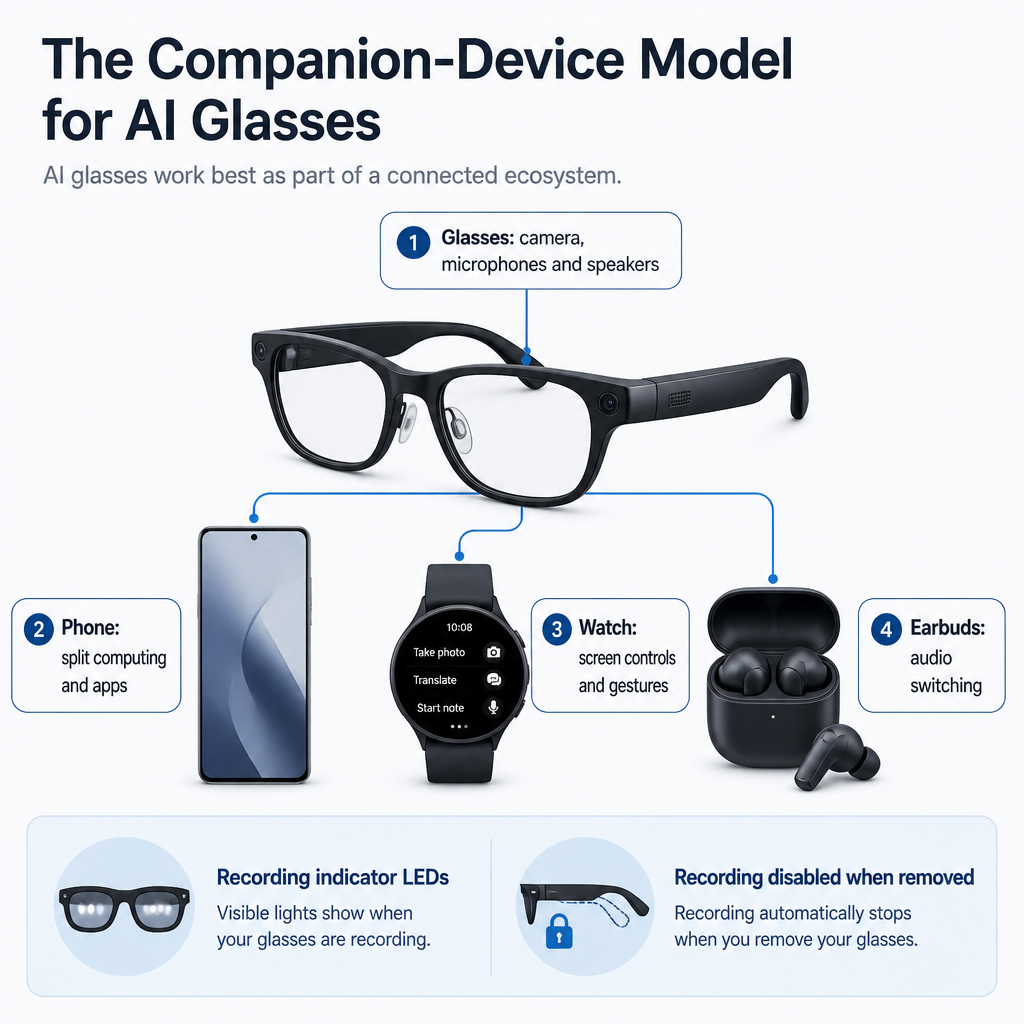
This appears to be the emerging shape of wearable AI. Rather than relying on one device to do everything, several devices contribute their own strengths. A watch stays on the wrist, earbuds make private audio convenient, and glasses offer a camera-level view of the surrounding world. The phone remains the powerful and familiar hub.
Trust may prove harder than the hardware
Context-aware glasses bring back a familiar concern: how can people tell when the camera is recording? Samsung says the design includes outward-facing and inner LED indicators, along with wear detection that disables recording when the glasses are removed. Another feature is intended to stop recording if the external indicator is blocked. Once the product reaches consumers, those safeguards will matter as much as its battery life or AI features.
Samsung hasn’t announced a price or release date for the eyewear. Even so, the July unveiling offers a useful signal. The next smart-glasses race may have less to do with replacing phones and more to do with cutting down how often we need to pull one out.
For now, that’s a promising direction. It doesn’t assume phones are becoming obsolete. Instead, it recognises why they’ve remained indispensable.