Robotaxis have long been presented as cars fitted with unusually sophisticated sensors. Waymo’s latest technical disclosure points to a more useful description: they’re becoming purpose-built edge AI machines on wheels.
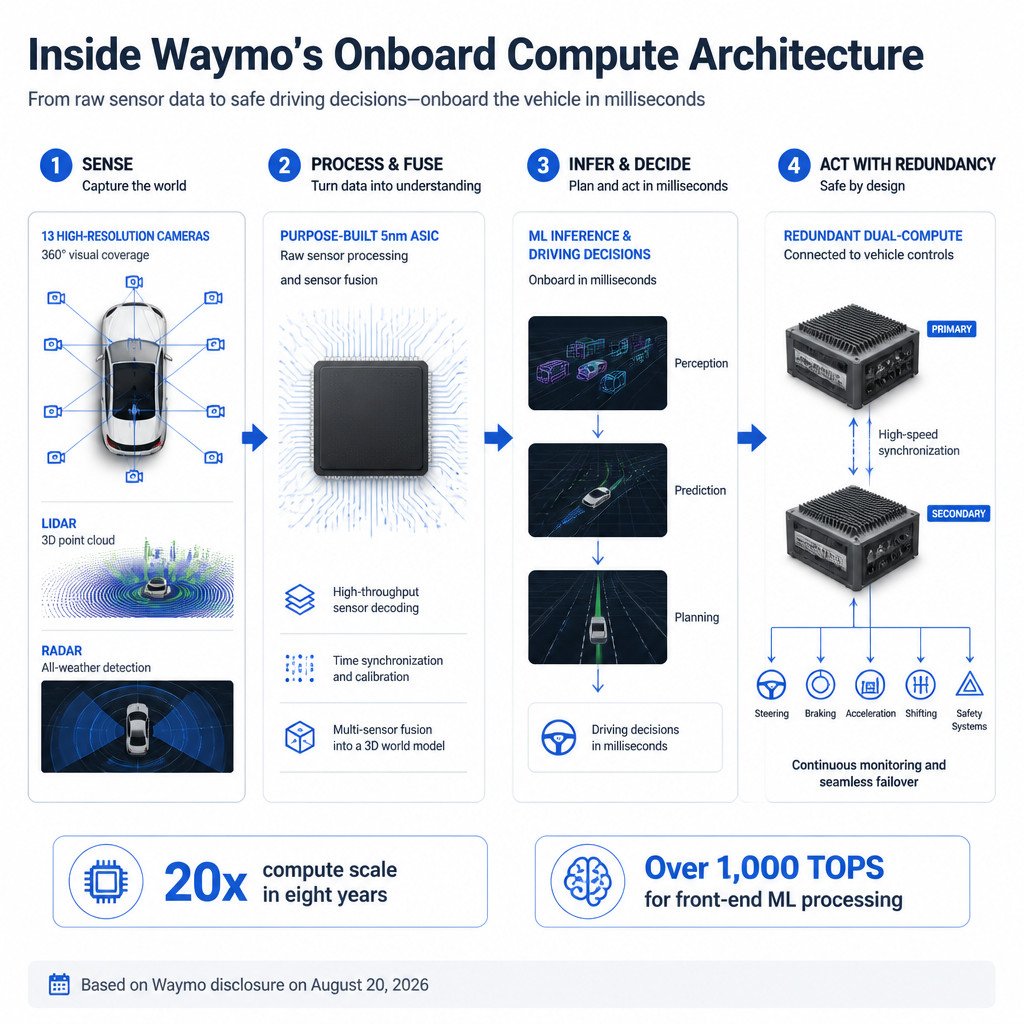
On August 20, Waymo published a detailed look at the compute system inside the Waymo Driver, including a custom 5nm application-specific chip, or ASIC. According to the company, the chip processes raw lidar, radar and camera data before passing it to the main machine-learning stack. It delivers more than 1,000 TOPS of ML performance for front-end processing and models. (waymo.com)
Why a robotaxi company is talking about silicon
Carmakers routinely discuss batteries, motors and sensor suites. An autonomous-driving company publicly explaining its chip architecture is far less common. That’s why Waymo’s post is attracting attention. It shows that scaling driverless vehicles involves much more than adding sensors to a car.
Waymo says its onboard system has to turn sensor input into driving actions within milliseconds. The hardware must keep working through vibration and extreme temperatures, while retaining a backup path in case something fails. Its design has two independent compute systems that normally run parallel workloads. If one develops a fault, the other can take over. (waymo.com)
Why custom silicon matters
Cloud AI can usually tolerate a short delay. A vehicle traveling through a busy intersection can’t. Every camera frame, radar return and lidar reading must be combined into a usable view of the road, then converted into a safe path quickly enough to make a difference.
That computing problem is different from running a chatbot, or even handling most driver-assistance features. Waymo says it has increased raw compute power 20-fold over eight years. Its latest system also processes data from 13 high-resolution cameras at the same time. Rather than treating the computer as an interchangeable box, the company says it co-designs its hardware, sensors and algorithms. (waymo.com)
The goal isn’t raw horsepower alone. Efficiency matters too. A robotaxi needs substantial computing power without sacrificing cabin space, battery range, quiet operation or reliability. Custom chips can be tuned to the particular mix of sensor processing and neural-network inference needed inside the vehicle, avoiding some of the compromises that come with a general-purpose platform.
Physical AI is becoming more vertically integrated
Waymo isn’t claiming that a chip by itself makes autonomous driving safe, and the announcement doesn’t amount to independent safety validation. Still, it offers a clear signal about the direction of physical AI. As robots, drones and self-driving vehicles move beyond demonstrations, their developers are increasingly likely to control more of the stack, including sensors, software, cooling, power delivery and specialized compute.
Waymo continues to name partners including AMD, Micron, NVIDIA, Samsung, Sandisk, Socionext and TSMC. That helps clarify what vertical integration means here. It doesn’t require doing everything alone. Instead, it means tailoring the components that determine whether an AI system can respond reliably in the physical world. (waymo.com)
Riders may never see the chip beneath the trunk. For the robotaxi industry, though, it could become one of the clearest signs that autonomous vehicles are developing into a distinct class of edge-computing product.