AI providers can identify the model that generated an answer, but users usually have no practical way to verify that claim. Provable AI inference is a cryptographic method meant to change that. It allows a provider to attach proof that a response came from a specific declared model without exposing the model’s valuable private weights. Interest in the idea grew on November 2, 2026, when Anthropic released FlashProve, an open-source research prototype for this type of verification.
What provable AI inference means
Inference is the process of running a trained AI model on a prompt to produce an output. Provable AI inference adds evidence that the computation was actually performed by the stated model.
That matters when a customer, auditor, or regulator needs more than the provider’s word. An organization, for instance, might want to confirm that an AI service used an approved model version rather than a less expensive substitute or an altered system.
How it works
The provider begins by creating a cryptographic commitment, a short digital fingerprint linked to one exact set of model weights. The weights themselves stay private.
When the model responds to a prompt, the provider produces a mathematical proof alongside the answer. In systems such as FlashProve, that proof uses a zero-knowledge succinct argument, commonly known as a zkSNARK. It enables a verifier to check the claim that the committed model generated the stated output while revealing no useful information about the weights or the model’s internal calculations.
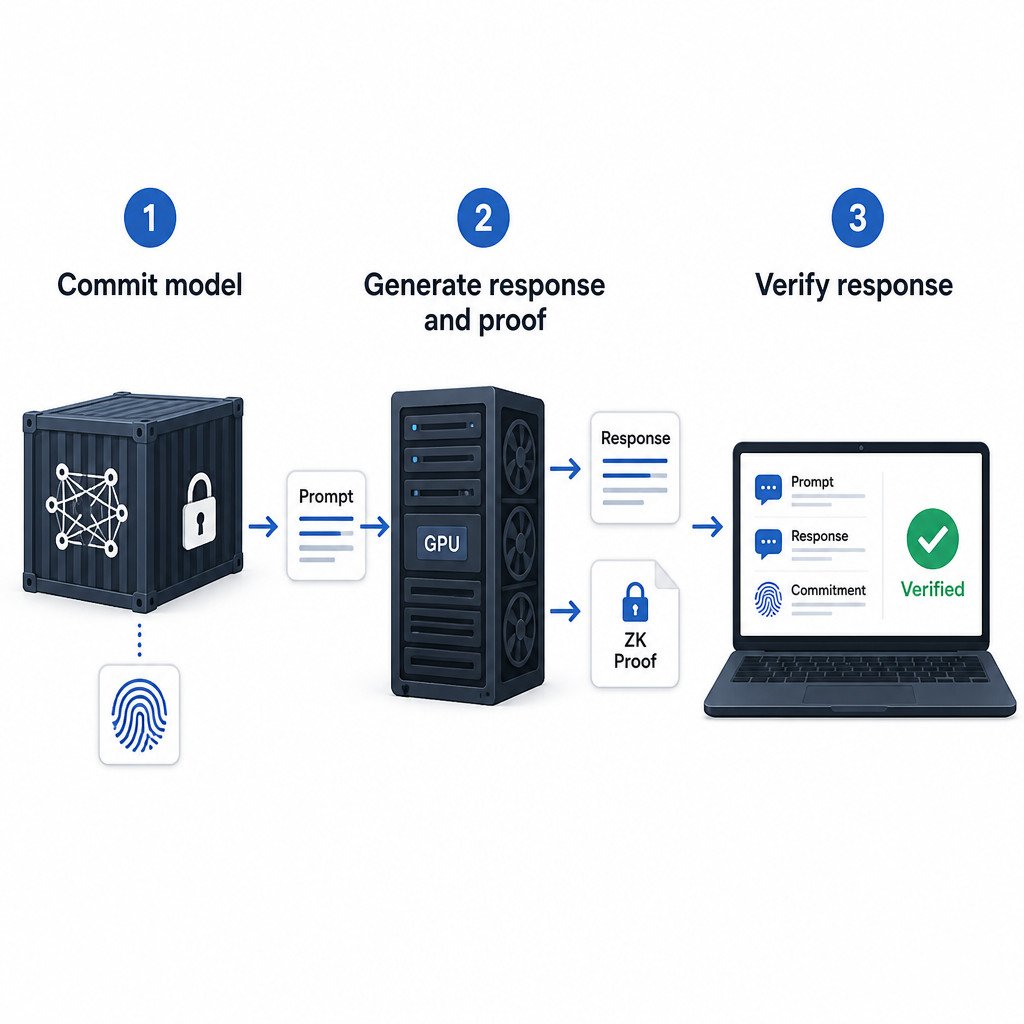
To verify the result, the checker needs the commitment, the original prompt, the response, and the proof. Rather than rerunning a massive model, it can validate the proof with far less computing power.
Why it matters
As AI becomes part of business workflows, security tools, and regulated environments, model identity carries more weight. A cryptographic check could help customers confirm that the promised model was used, give auditors a way to examine defined deployments, and make unnoticed model substitution more difficult.
The technology is still in its early stages and comes with overhead. Producing proofs takes far more computing power than standard AI inference. It also can’t show that an answer is correct, safe, unbiased, or appropriate. The guarantee is narrower: a particular committed model produced a particular response under the stated setup.
Still, that limited guarantee could matter more as AI services become increasingly difficult to inspect from the outside.