
High Bandwidth Compute, or HBC, is Qualcomm’s name for a near-memory computing architecture designed for AI inference. It drew fresh attention after Qualcomm said on November 2, 2026, that it had validated its first HBC silicon, including the memory read-write path and near-memory computations. The approach targets a growing AI challenge: moving model data between memory and processors can take significant time and energy. (qualcomm.com)
What Is High Bandwidth Compute?
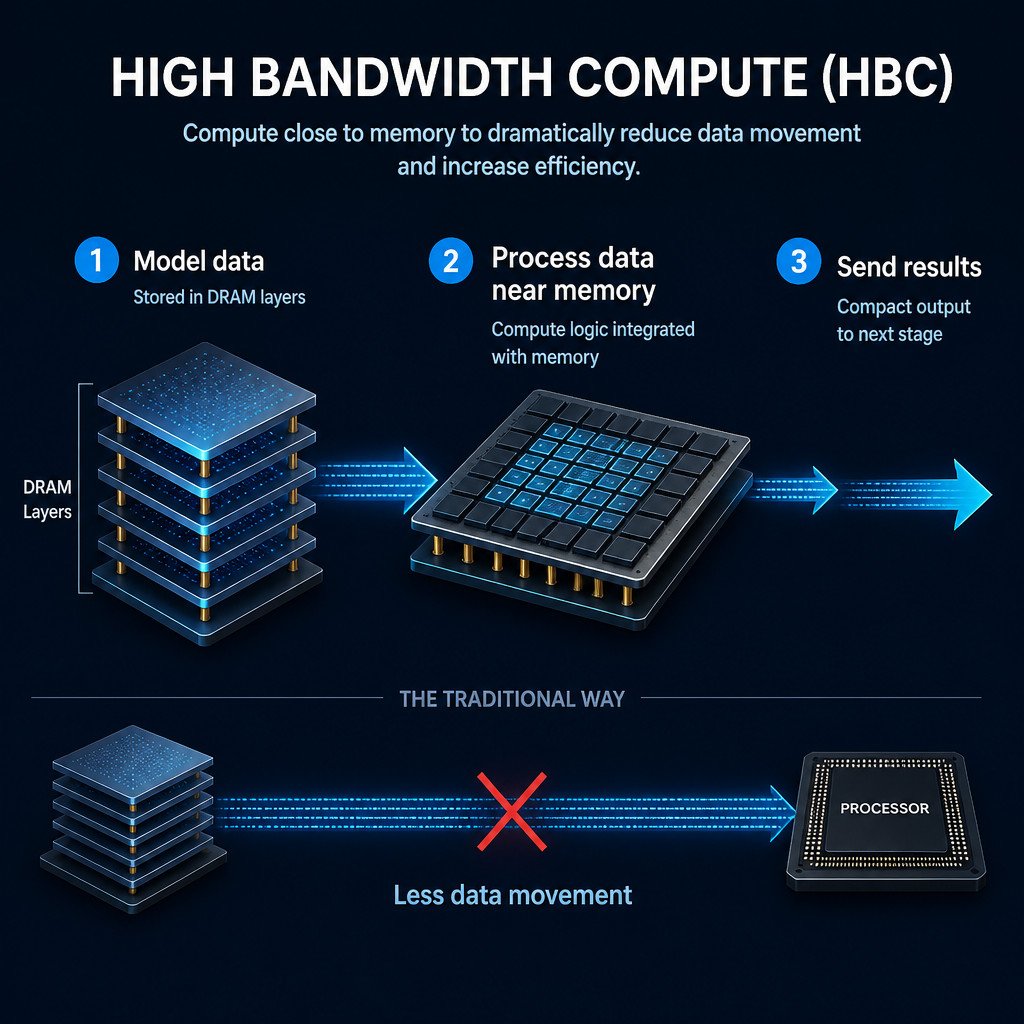
HBC isn’t a general industry standard. It is Qualcomm’s version of near-memory computing, a design that puts processing logic extremely close to memory. Instead of repeatedly moving large amounts of model data from DRAM to a separate main processor, HBC is meant to handle the most data-heavy operations near where that data resides. (qualcomm.com)
That matters most for generative AI inference, the stage in which a trained model responds to a prompt and generates tokens. Large language and multimodal models continually pull model weights and other data from memory. If the hardware can’t get that data fast enough, it sits idle waiting, a constraint commonly known as the memory wall.
How HBC Works
Qualcomm describes HBC as a 3D-stacked silicon design that more tightly bonds memory and compute. Data can be processed inside the package through much wider internal paths near the memory, rather than relying as heavily on connections that send it to a separate system-on-chip. Smaller intermediate or final results are the ones that need to travel farther through the system. (qualcomm.com)
Why It Matters
For AI infrastructure, cutting down data movement could reduce latency and energy use while improving effective memory bandwidth. That may help cloud providers and enterprises serve AI models more efficiently, particularly workloads that produce responses continuously or work with long contexts.
HBC is still a Qualcomm platform technology, not a broadly deployed hardware category. Qualcomm plans to integrate its first-generation HBC into its Dragonfly AI250 inference platform, which the company expects to sample in the first half of 2027. The recent silicon validation matters because it moves the idea beyond architectural claims and closer to product integration. (qualcomm.com)

? AI Memory Explained)