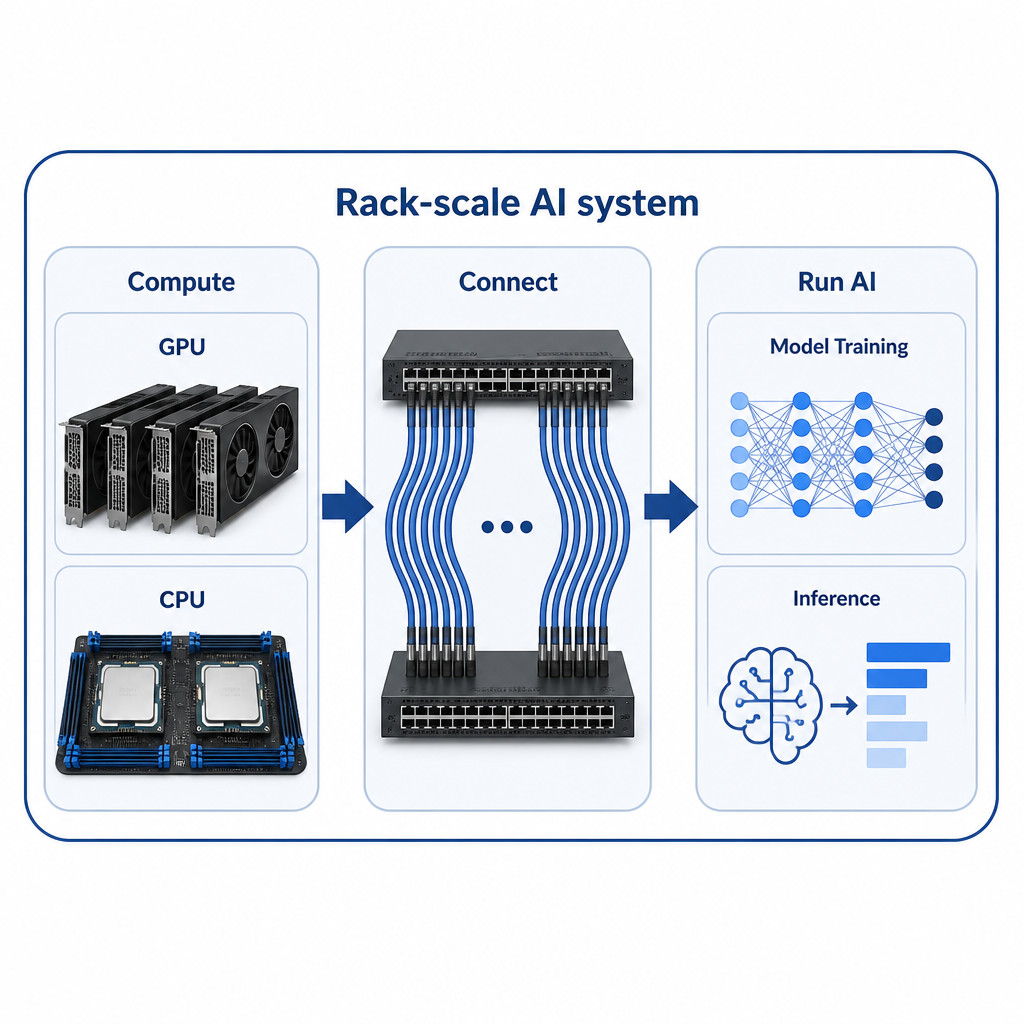
The next AI chip race may have less to do with building a faster general-purpose GPU and more to do with designing hardware for one model at a time.
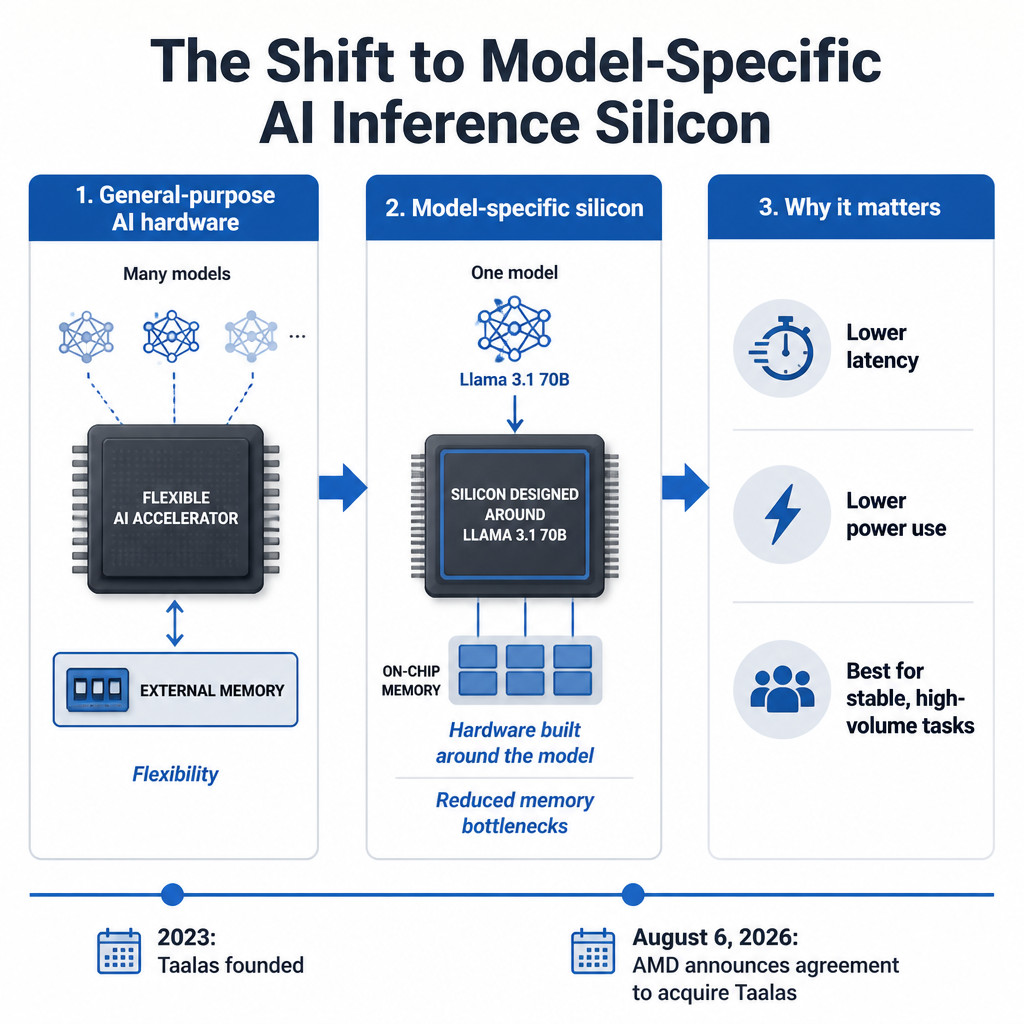
That idea drew fresh attention on August 6, 2026, when AMD announced a definitive agreement to acquire Taalas, a Toronto-based specialist in AI inference silicon. Taalas isn’t trying to produce another accelerator that can handle every type of AI workload. Its main proposition is different: build the hardware around the model.
Why model-specific chips are gaining attention
Most large language models run on flexible hardware, including GPUs and other accelerators that can be programmed for a wide range of models and tasks. That versatility matters during training and experimentation. Once a model is stable and serving a predictable, high-volume workload, though, the cost of that flexibility can start to look like unnecessary overhead.
Inference happens when an already-trained model generates an answer, classifies an image or takes the next step in an AI workflow. At scale, moving model data between compute and memory can limit speed while driving up cost and power use. AMD says Taalas optimizes inference dataflows to reduce those compute and memory bottlenecks. It plans to integrate the technology into its accelerator roadmap alongside AMD Instinct GPUs.
The acquisition reflects a broader trend. AI infrastructure is becoming more specialized as companies seek cheaper, faster ways to serve the same model again and again. Instead of expecting one chip to run everything, the industry is moving toward a mixed approach in which flexible GPUs work alongside hardware tuned for particular workloads.
What Taalas brings
Taalas has demonstrated a hard-wired version of Meta’s Llama 3.1 8B model on its HC1 platform. According to the company, its design combines storage and computation on a single chip, avoiding some of the external-memory complexity found in conventional AI systems. Taalas also says it can realize a previously unseen model in hardware in roughly two months.
Those remain company claims, not guarantees of broad commercial performance. Even so, the idea is appealing for real-time, high-volume inference. Customer-service systems, coding assistants, voice interfaces and automated agents may all benefit if responses can be delivered faster while using less power.
Flexibility remains the trade-off
A chip designed around a specific model won’t replace GPUs across the board. AI models change quickly, and hardware tailored to one model may lose its advantage as architectures, weights or customer requirements shift. Taalas has acknowledged that its first hard-wired Llama system uses aggressive quantization and can show quality trade-offs compared with GPU benchmarks.
That helps explain why AMD’s move matters. Rather than betting entirely on fixed-function chips, the company is adding specialization to a wider stack that already includes CPUs, GPUs, software and rack-scale systems. In the near term, AI hardware probably won’t become less varied. It will become more purpose-built.
For readers, the signal is clear: the cost of AI will increasingly depend on both the model being used and whether the hardware was designed to run it efficiently.