
Physical unclonable functions, better known as PUFs, are drawing more attention as chipmakers and security companies search for stronger ways to verify that a connected device is genuine. In July 2026, BTQ Technologies and ICTK announced the design of a security chip that combines PUF technology with quantum-era security tools. The news brought a once-specialist term to a wider audience.
What Is a Physical Unclonable Function?
A PUF is a hardware security feature that uses tiny, unavoidable differences introduced during chip manufacturing to create a unique digital identity. Even chips built from the same design have microscopic variations in their transistors, wiring or electrical behavior. By measuring those differences, a PUF produces an output specific to that physical chip.
It’s often compared to a fingerprint. The key difference is that the identity comes from the hardware itself, rather than a serial number stored in memory. As a result, an attacker can’t copy it merely by duplicating stored data.
How Does a PUF Work?
During setup, the device records dependable PUF responses or uses them to reconstruct a cryptographic secret. Later, the chip is measured again under expected operating conditions. If the new response is a close enough match, the system can confirm that it’s communicating with the same genuine device.
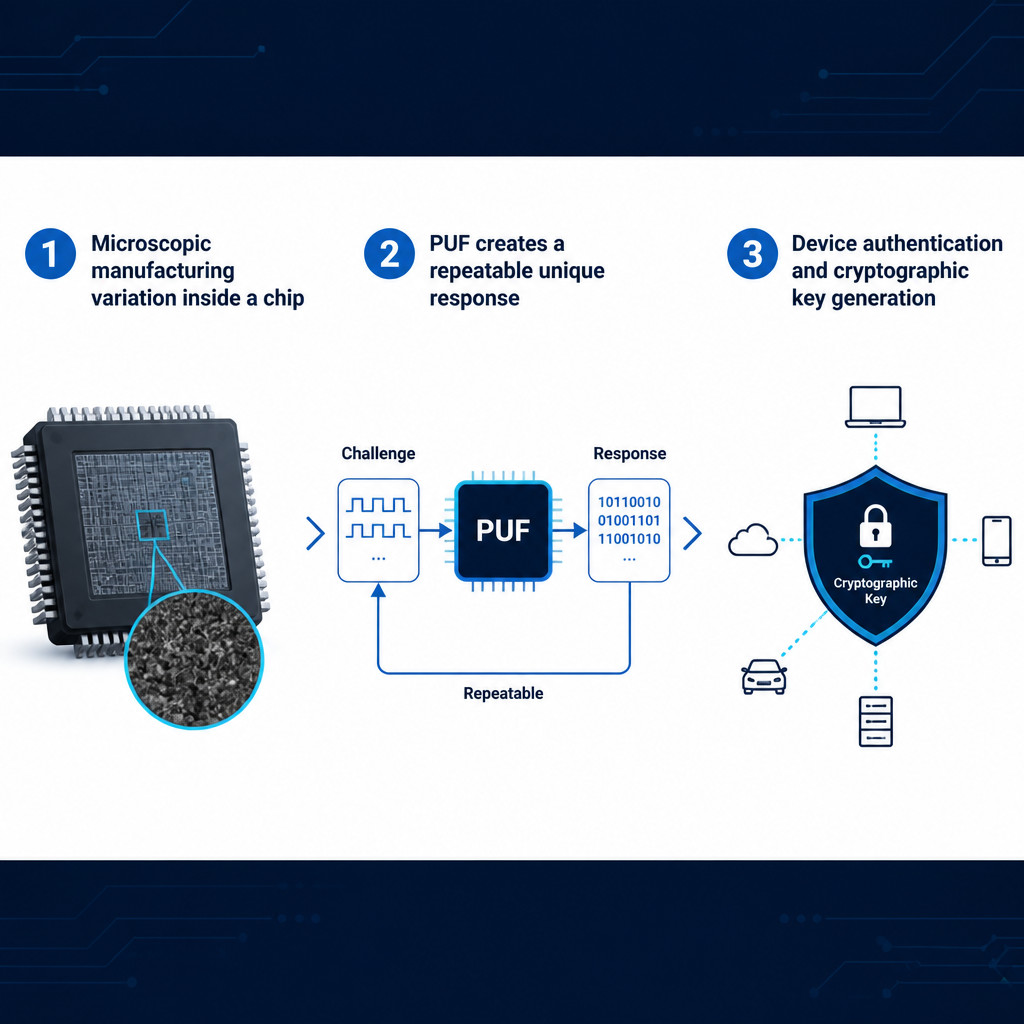
PUFs commonly serve two purposes: authenticating a device to a network or service, and deriving encryption keys inside the chip as needed. With key derivation, a long-term key doesn’t have to remain permanently in ordinary memory, which reduces the value of stealing a stored key.
Why Does It Matter?
Connected products need a trustworthy starting point for security. A PUF can provide that hardware root of trust, forming a foundation before the system relies on software, passwords or cloud accounts. This approach can be used in IoT sensors, industrial equipment, smart appliances, vehicles, secure elements and network hardware.
A PUF isn’t a complete defense by itself. It must be designed to stay stable as temperature, voltage and aging change, and it works alongside cryptography and secure software. Even so, PUFs offer a practical way to tie a device’s identity to the silicon itself. That connection is becoming more relevant as manufacturers plan for longer device lifetimes, stricter supply-chain checks and an eventual shift to post-quantum cryptography.






?)