AI-assisted cyber defense is drawing fresh attention as governments and organizations search for ways to manage the rising volume of security alerts. On August 10, 2026, California announced an AI Cyber Defense Program designed to support vulnerability detection, network hardening, and incident response for critical infrastructure. The announcement points to a broader shift toward using AI to process security data faster, rather than relying on manual investigation for every decision.
What AI-assisted cyber defense means
AI-assisted cyber defense uses artificial intelligence to support cybersecurity tasks. These may include detecting suspicious behavior, finding exposed systems, ranking alerts by urgency, and suggesting possible response actions. Such tools can operate within a security operations center, where analysts monitor networks and investigate potential attacks.
That doesn’t mean an AI system should control a company network on its own. In a well-designed deployment, people define permissions, review actions with serious consequences, and remain responsible for the final decisions.
How it works
Security tools produce a constant flow of information, including login records, device activity, network traffic, software vulnerability reports, and warnings from endpoint protection systems. AI systems can review these signals together, search for unusual patterns, and connect events that might seem unrelated when examined separately.
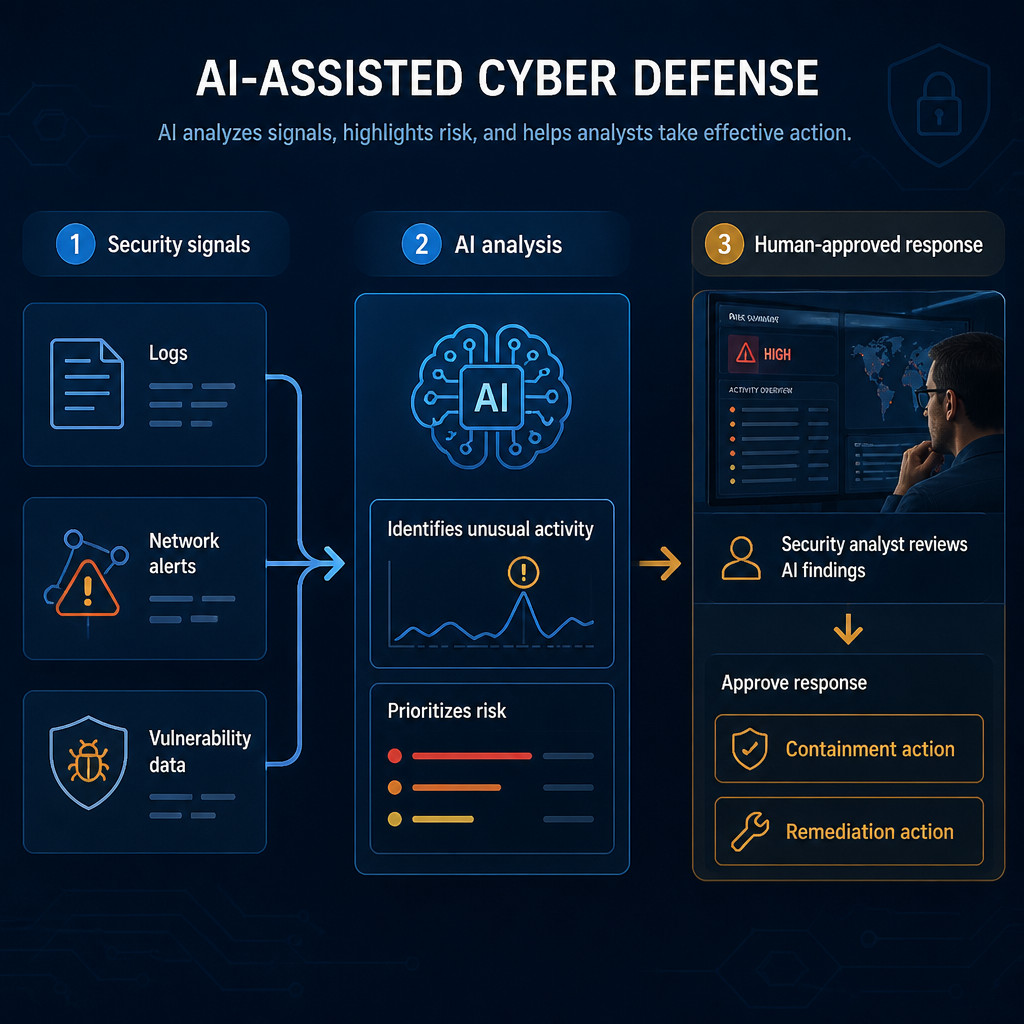
For instance, an AI tool might identify an unfamiliar login, unusual file access, and an unexpected change to a server configuration as parts of the same possible incident. It can help an analyst move the case higher in the queue, summarize the available evidence, and recommend established steps such as isolating a device or requiring a password reset.
Why it matters
Security teams often receive more alerts than they can investigate promptly. AI can take on some of the repetitive work, giving experts more time to focus on incidents that appear most serious. This can be especially useful for hospitals, utilities, public services, and other organizations responsible for critical systems.
AI-generated findings still have to be checked. Models can get things wrong, while attackers may attempt to influence automated systems through misleading data or instructions. For that reason, AI-assisted cyber defense works best as a support layer alongside existing security controls, tested response plans, and trained human analysts.