As AI agents gain permission to retrieve internal information, call APIs, and carry out multi-step tasks, ordinary application logs may no longer be enough to prove those actions followed the rules. TRACE is designed to address that gap. On August 25, 2026, the Linux Foundation announced that it had received TRACE as an open specification, bringing it to the attention of more AI infrastructure and security teams.
What Is TRACE?
TRACE stands for Trust, Runtime Attestation, and Compliance Evidence. Currently available as a developer-preview specification, it creates a portable, cryptographically verifiable record of an AI agent or another confidential workload while that workload is running.
A TRACE record is meant to answer practical questions. What model or software ran, and where? Which policy governed it? What class of data did it access, and which tools did it invoke? Instead of depending entirely on an operator’s audit log, the record can be linked to evidence generated by protected hardware.
How TRACE Works
TRACE brings several forms of evidence together in a signed Trust Record. A trusted execution environment, or TEE, can measure the software operating within its protected area and generate hardware attestation. That attestation provides evidence that a specific workload ran in the expected environment.
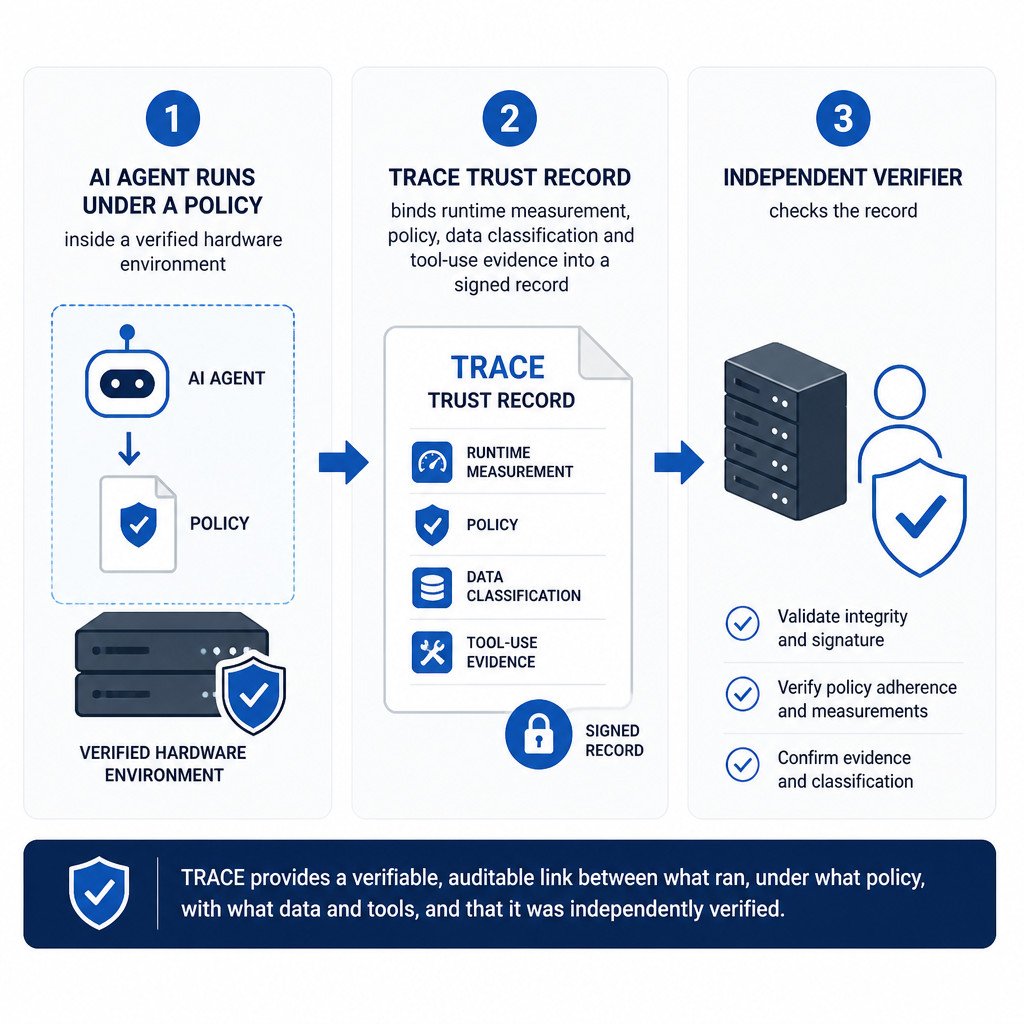
The specification binds that measurement to information such as workload identity, policy details, data classification, and a hash of tool-use activity. A verifier can check the record’s signature, then determine whether its claims match an approved configuration. The aim is to make verification work across different cloud and hardware platforms, without tying it to a single vendor.
Why TRACE Matters
AI agents can perform consequential actions in software systems. An activity log alone, however, can be changed and may not prove where it came from. TRACE is intended to provide stronger evidence for security reviews, compliance checks, and investigations involving sensitive AI workloads.
It doesn’t judge whether an agent’s policy is sound, nor does it prevent every form of misuse. Instead, TRACE offers a common format for verifying evidence about execution. That difference matters because organizations can evaluate AI systems using the same type of record even when the model, cloud provider, or confidential-computing hardware varies.
Why It Is Getting Attention Now
TRACE was introduced earlier in 2026 and contributed to the Linux Foundation on August 25. The current version is still a developer preview. But its move toward vendor-neutral governance has made it newly relevant to teams building AI agents that need to be audited.