A newly published NIST report has drawn attention to m-NGAC, or embedded Next Generation Access Control. The concept is fairly direct: rather than depending mostly on individual apps to decide who can view sensitive information, m-NGAC places detailed access-control policy inside the database. NIST released its report on the approach on August 27, 2026, making it newly relevant for teams focused on database security and AI-era data protection.
What Is m-NGAC?
m-NGAC is a proposed method for applying fine-grained access control within a relational database. Fine-grained control means policies can work at a much more detailed level than allowing or denying access to an entire database or table. Rules may protect specific rows, columns, or fields that contain salaries, medical information, account numbers, or customer identifiers.
It builds on Next Generation Access Control, or NGAC, a policy framework standardized by ANSI/INCITS. The “m” refers to embedding that policy capability in the database management system.
How m-NGAC Works
When a person, application, reporting tool, or SQL editor submits a query, the database checks the request against centrally managed NGAC policies before it returns or changes data. Those policies can take into account the requesting user, their role, organizational relationship, and the data they want to access.
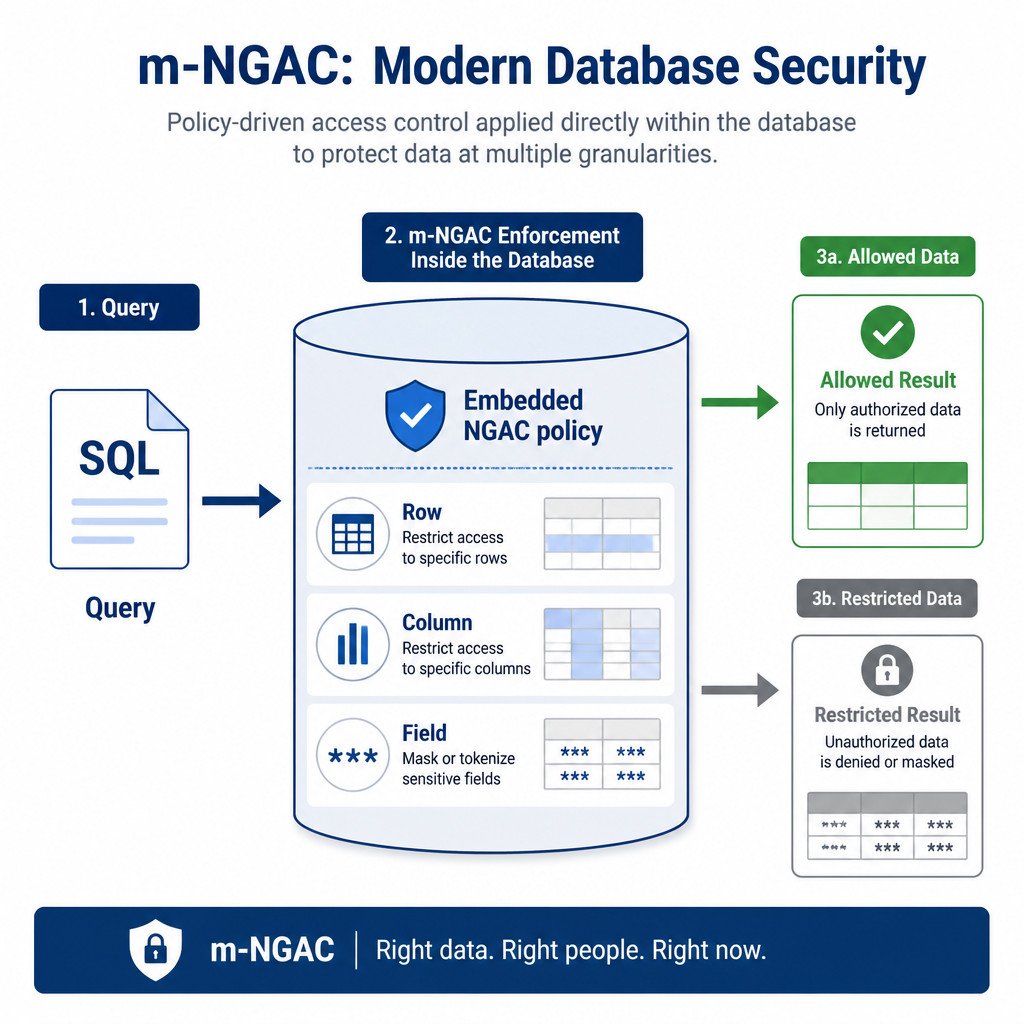
Since enforcement happens where the data lives, the same restrictions can apply no matter which approved tool is used to reach the database. The query can still follow its usual logic, while restricted values remain protected under policy.
Why It Matters
Many organizations handle permissions in application code. That can lead to inconsistent rules when multiple apps, dashboards, scripts, and administrators access the same database. It also creates a risk that a direct connection or an overlooked tool could reach data without the intended safeguards.
m-NGAC is meant to make access rules more consistent by enforcing them closer to the records themselves. It could be useful in healthcare, finance, government, and other organizations that share sensitive databases across multiple systems. It doesn’t replace encryption, identity management, or secure software design, but it adds a more precise layer of control over who can view or modify particular data.