
Model Context Protocol (MCP) is drawing new interest as companies search for practical ways to let AI assistants interact with real business systems. Recent infrastructure announcements, including Digital Realty’s ServiceFabric MCP, show that the concept is moving past chatbots and into data centers, software tools, and day-to-day enterprise operations.
What Is Model Context Protocol?
Model Context Protocol is an open standard that connects an AI application with outside information and actions. Rather than building a separate custom connection for every database, calendar, code repository, or internal service, developers can make those capabilities available through an MCP server.
It works like a common connector for AI. An assistant can use MCP to identify the available information and tools, then request access in a standard format. MCP doesn’t make the AI model smarter on its own. It gives the model a structured, controlled way to work with systems beyond the chat window.
How MCP Works
MCP follows a host-client-server design. The host is the AI application a person uses. Within that application, an MCP client connects to an MCP server, which represents a service such as a file system, API, database, or developer tool.
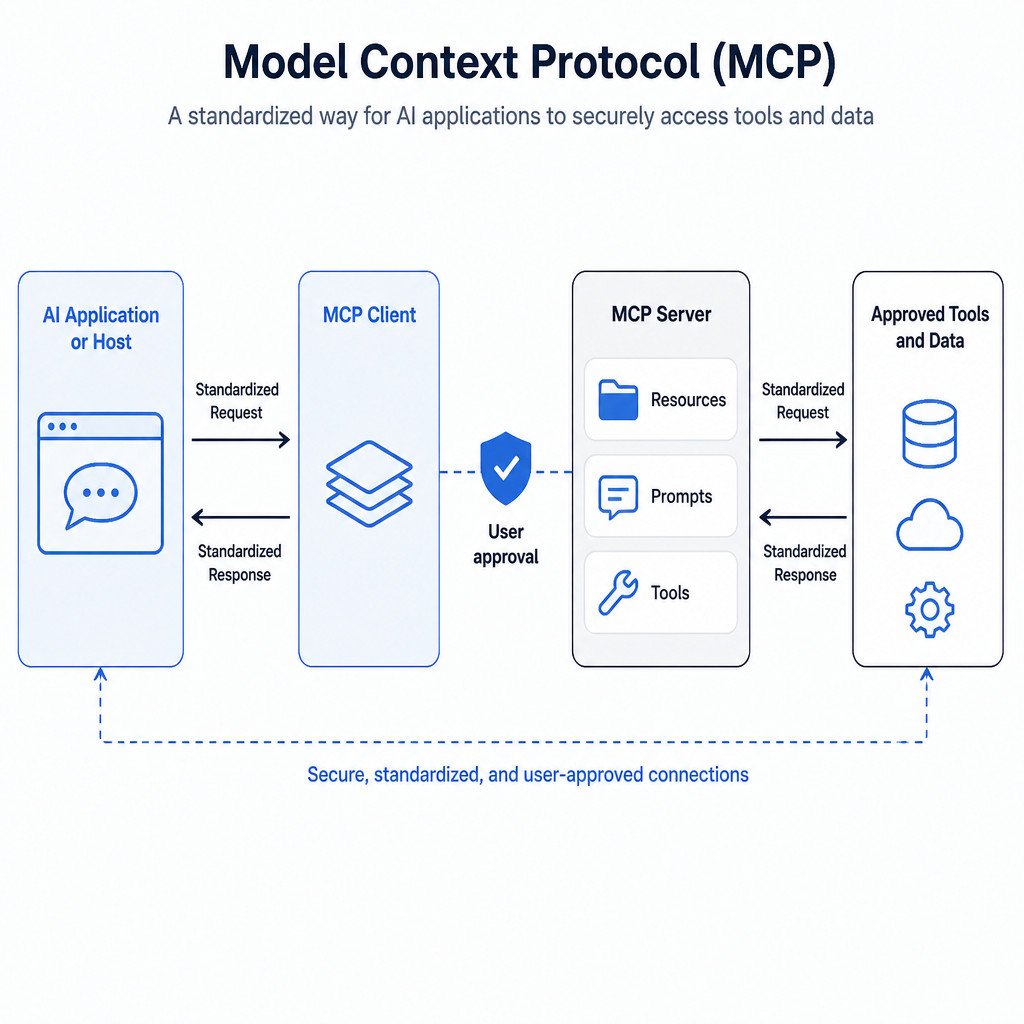
An MCP server can offer three main kinds of capability: resources for contextual data, prompts for reusable instructions or workflows, and tools for actions like searching records, running a calculation, or creating an item in another service. Messages use a standard machine-readable format, so a single server can potentially work with several compatible AI applications.
Why It Matters
AI agents are useful only if they can safely access the information and services required to complete a task. MCP cuts down on one-off integrations and can make those connections easier to reuse across AI products.
Security and user control matter, too. Connecting an assistant to tools may expose sensitive data or allow real actions, so well-designed MCP implementations should limit permissions, authenticate access, and give people a way to review or deny consequential requests.
That mix of interoperability and control is why MCP is becoming an important building block for more capable, connected AI assistants.

?)