For years, smartphone camera AI has mostly stepped in after the shutter press, brightening a dark face, removing an unwanted passer-by or sharpening a soft image. Google’s Pixel 11 launch on August 12 points to what comes next. The camera is beginning to decide which moment is worth keeping.
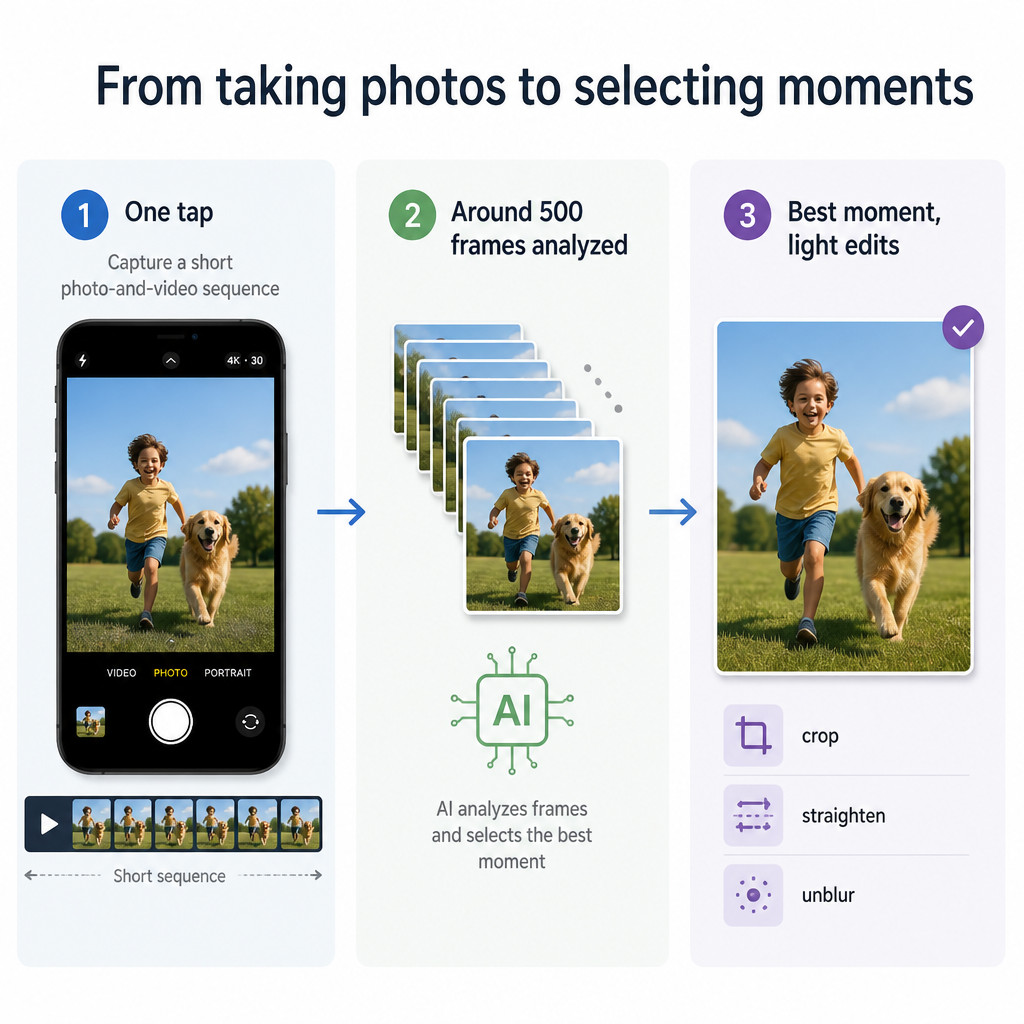
Google introduced Magic Capture with the Pixel 11 lineup. The company describes it as a one-tap mode that records a short sequence of photos and video, analyzes roughly 500 frames, picks the strongest moments and makes light edits such as cropping, straightening or unblurring. Google says the feature is designed to help people stay present rather than repeatedly trying to time the perfect shot.
It may sound like another camera-mode update, but it signals a more meaningful change in phone photography. AI is shifting from improving images to choosing moments.
The camera race is shifting to timing
Most missed photos aren’t the fault of a weak sensor. A child glances away. Someone blinks, or a pet moves at the exact second the shutter fires. The photographer is often missing from the moment too, busy watching the screen, shooting bursts and checking whether any of them worked.
Magic Capture approaches that problem by treating a tap as the start of a capture window, rather than a request for a single frozen frame. The result is still drawn from something the camera actually recorded. But the phone handles more of the work once left to the person behind it, scanning the sequence, finding an appealing instant and cleaning up the composition.
Google isn’t alone in using computational photography, though the Pixel 11 makes this direction especially clear. The launch pairs Magic Capture with a wider set of AI-powered camera tools, including faster low-light shooting on Pro models. Hardware plays a part as well. Google says the new Tensor G6 processor improves power efficiency and helps support the lineup’s new AI functions.
Convenience brings a creative trade-off
The appeal is easy to see. Casual photographers don’t necessarily want hundreds of almost identical frames. They want one photo that feels right. A camera that sorts through a chaotic sequence could make spontaneous pictures more dependable, particularly at parties, sporting events and family gatherings.
Still, “best” is subjective. The technically cleaner frame won’t always be the one a photographer prefers. An imperfect laugh, a streak of motion or an off-center composition might be what gives the picture its character. As these tools become more common, camera apps will need to explain their choices and let users keep control of the original material.
Why this is gaining attention now
The Pixel 11 launch comes as phone makers look for upgrades people can notice in everyday use. Slimmer camera hardware and faster chips have value, but AI that eases the worry of missing a real moment is easier to grasp. Google is betting that the next standout smartphone camera feature won’t be a larger number on a specification sheet. Instead, it will be a phone that quietly helps people stop chasing the shot and rejoin the scene.