Google’s August 12 Pixel 11 launch delivered the usual flagship upgrades, including improved cameras, a new Tensor G6 chip and more Gemini features. Yet one of the smallest additions is drawing unusual attention. It isn’t a camera mode or an AI benchmark, but a light on the back of the phone.
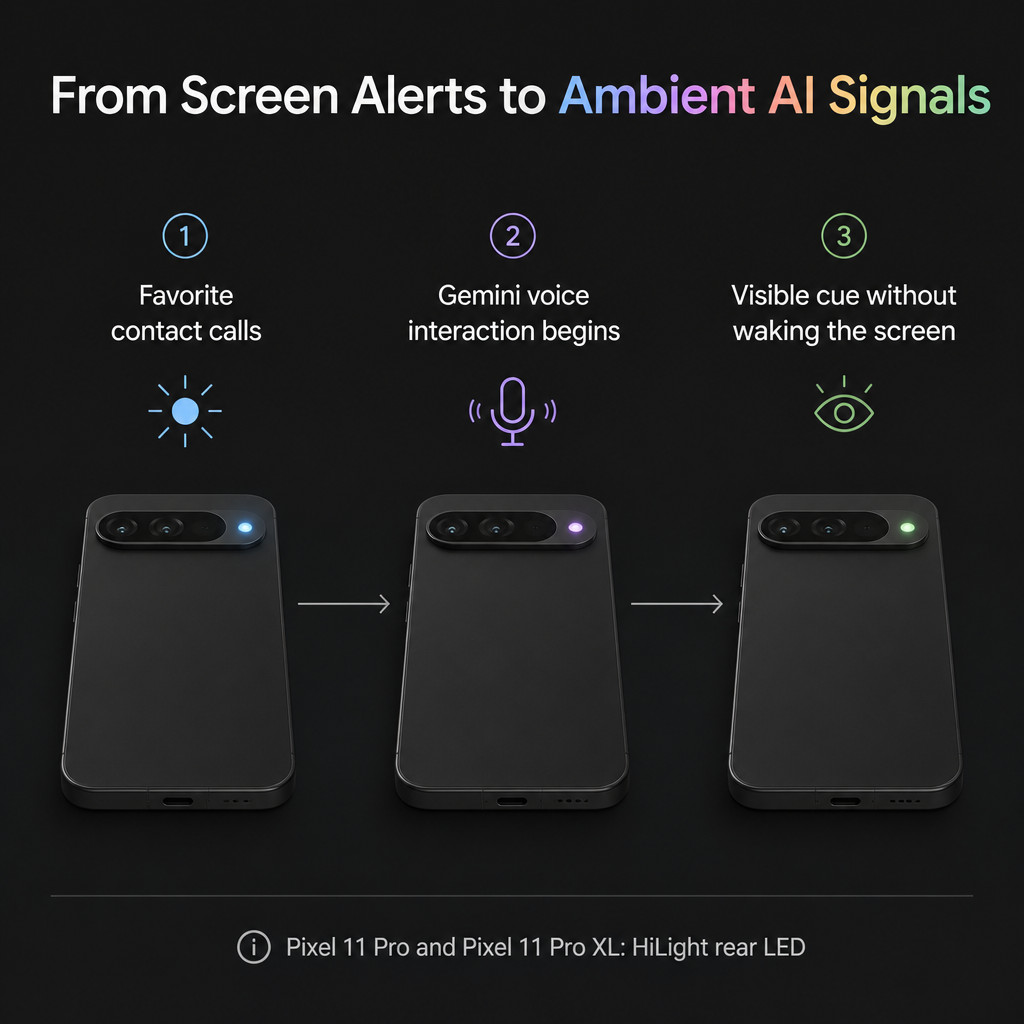
Google has added HiLight, a rear LED system, to the Pixel 11 Pro and Pixel 11 Pro XL. Owners can assign colors to selected contacts, and the phone lights up in the chosen color when that person calls while it’s lying face down. HiLight also activates when Gemini starts listening to a voice request. The Associated Press reported that contact colors work alongside Pixel’s existing face-down “Flip to Shhh” behavior.
AI needs a visible state
HiLight doesn’t make Gemini any smarter. What it does is give an AI interaction a physical signal that’s easy to notice without looking at the screen.
Voice assistants leave users with a small but persistent uncertainty. Did the device hear the wake phrase? Is it listening now, and has it stopped? The screen can answer those questions, but only when you can see it. A discreet rear light can provide the same information while the phone sits face down on a table, charging pad or desk.
Google is treating AI more like an ambient part of the phone than an app people deliberately open. It’s a subtle change in the hardware. As assistants become more proactive and voice-driven, phones will need clearer ways to show what they’re doing without making users check the lock screen again.
Why HiLight is getting attention now
The timing is straightforward. Google unveiled the Pixel 11 family on August 12, and HiLight is among the most visible additions to the Pro models. Hands-on coverage confirmed that the light can signal both selected callers and Gemini voice activation. Tom’s Guide noted that the rear LED is exclusive to the Pro phones, while the broader lineup also introduces the 2nm Tensor G6.
Reaction has been mixed, and that’s part of what makes the feature interesting. Some Pixel enthusiasts see it as a useful way to notice important calls without giving up the calm of a face-down phone. Others have written it off as a limited novelty, particularly because its current uses appear narrowly focused. A recent Pixel community discussion reflected that split, with readers debating whether a light for calls and Gemini provides useful context or amounts to decorative hardware.
The real test will be restraint
HiLight will work only if its signals remain easy to understand. Assigning a color to a partner or family member is intuitive. A constant rainbow of app alerts would soon become another source of notification fatigue. There’s an etiquette issue too, since an external light can tell anyone nearby that a call is coming in or an assistant is active.
Still, the idea deserves attention. The next phase of AI phones may be shaped by more than what assistants can do. It may also depend on how clearly and calmly devices show what the AI is doing, without becoming socially awkward.