Humanoid robots are moving into a less glamorous but far more important phase: the reality check.
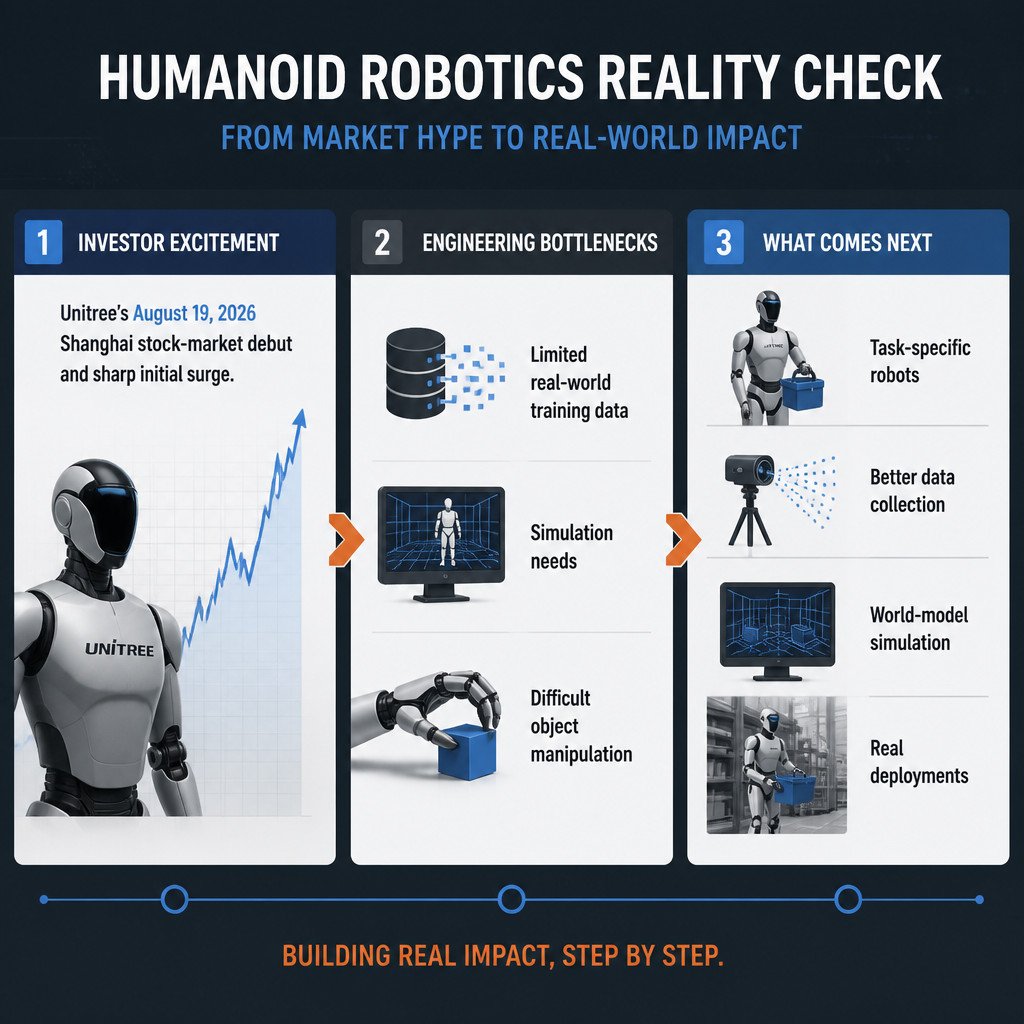
The trigger was hard to miss. On August 19, 2026, Chinese robot maker Unitree Robotics debuted on the Shanghai stock market. Its shares surged by as much as 629% at first, sending the company’s implied value sharply higher and signaling intense global investor interest in embodied artificial intelligence. Within days, though, the stock had surrendered much of those gains. The reversal renewed questions about whether the industry’s financial expectations are racing ahead of its products.
The Associated Press reported that Unitree’s listing reflected optimism surrounding China’s robotics industry. Meanwhile, Reuters coverage focused on fears of a bubble and the divide between investor excitement and business fundamentals.
Making robots move isn’t the hardest part
Modern humanoid machines can walk, maintain their balance, recognize objects, and deliver impressive demonstrations. Making them reliably useful in untidy, unpredictable environments is much harder. They must pick up unfamiliar objects, recover after mistakes, follow changing instructions, and complete the same task repeatedly without human help.
That explains why robotics developers are putting more attention on data rather than demonstrations. At Foxglove’s Actuate 26 conference in San Francisco on August 18 and 19, engineers working on physical AI discussed the shortage of high-quality training data, along with the need for better simulation, evaluation, and debugging tools. Foxglove describes Actuate as a developer conference for teams deploying autonomous systems in the real world.
In practice, robot makers need an equivalent of the data and testing infrastructure that helped software AI advance, adapted to account for physics. A language model can train on vast collections of text. A robot has to learn through camera views, sensor readings, physical actions, failures, and the consequences of making contact with the world.
Why world models are gaining attention
One possible answer is the use of world models, AI systems designed to simulate what might happen next. Rather than test every behavior solely on an expensive physical robot, developers can create scenarios, assess actions, and spot failures inside virtual environments.
NVIDIA’s Cosmos platform is one example of this approach. Recent research and industry tools are presenting video-based world models as a way to produce synthetic training data and test robotic policies before deployment. The method looks promising, but synthetic data isn’t a magic shortcut. If simulations don’t accurately represent friction, weight, lighting, unexpected obstacles, or human behavior, robots may learn strategies that fall apart in the real world.
The next stage will be narrower and more useful
In the near term, the likely direction isn’t a single robot capable of handling every household chore. Task-specific machines are more likely to appear first in controlled settings, including warehouses, factories, construction sites, and logistics operations.
That vision may sound less futuristic than a general-purpose android, but it offers a more credible route to scale. Each useful deployment can generate better data, reveal failure modes, and improve the models that control the hardware.
Unitree’s market roller coaster shows that public excitement remains intense. The engineering discussions at Actuate point to what must happen next. The industry has to move beyond viral demonstrations and billion-dollar valuations toward reliable manipulation that works outside the showroom.