For the past two years, smartphone AI has been busy proving it can write, summarize and answer questions. Google’s Pixel 11 launch on August 12, 2026 points toward the next phase: AI that doesn’t wait for a prompt.
The new Pixel family runs on Google’s Tensor G6 chip and Gemini Intelligence, but benchmark numbers aren’t the most interesting part. What stands out is how Google presents the phone itself, as a device that can recognize context, make choices and help complete small tasks without requiring the user to manage every step.
AI starts making judgments
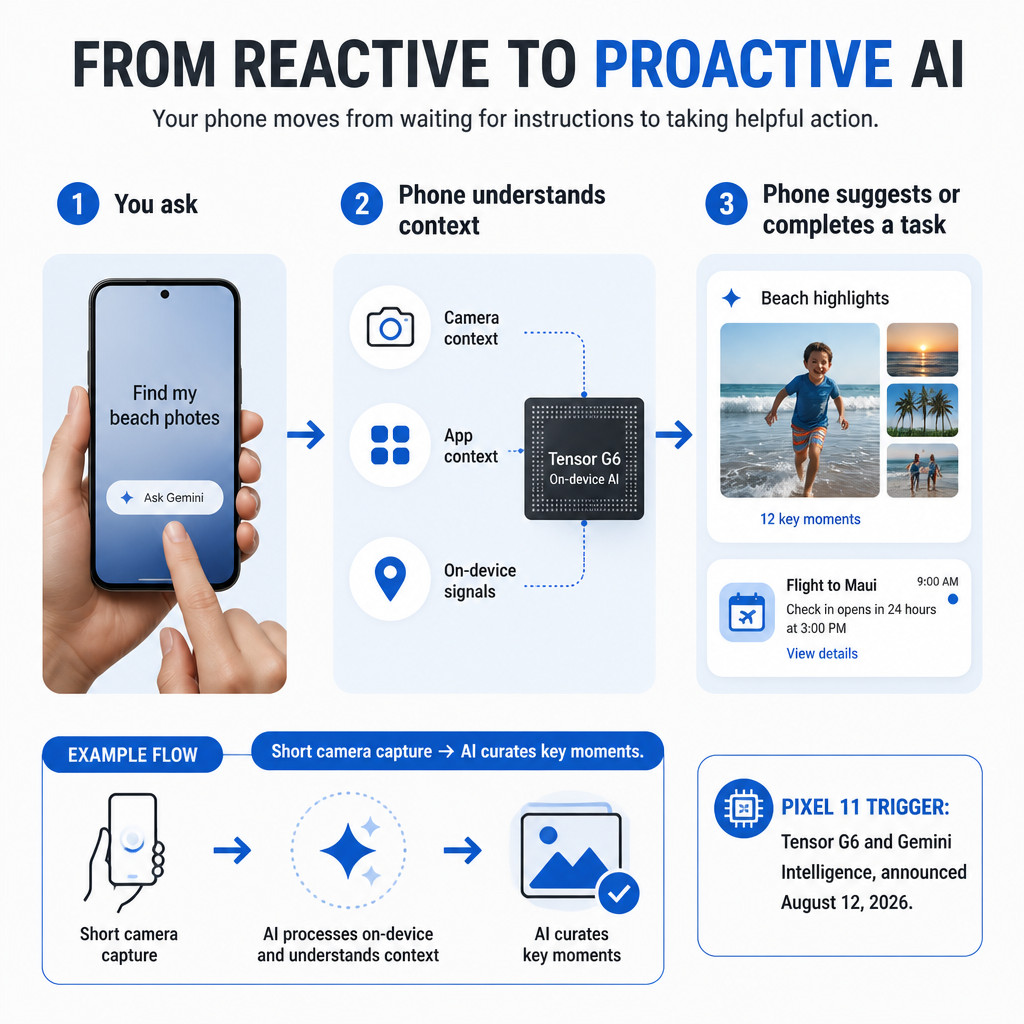
Consider Magic Capture, one of the Pixel 11 camera features. Rather than relying on someone to press the shutter at exactly the right moment, the phone records a short scene and automatically curates a collection of photos. Google says it’s meant to help people stay in the moment instead of chasing the perfect frame.
It sounds like a camera upgrade, but the feature points to a broader shift. The AI model isn’t merely enhancing an image. The software is deciding which moments are worth saving.
On its Pixel 11 product page, Google says Gemini Intelligence can predict what users need and work across apps to help them finish things faster. That’s a different promise from a chatbot sitting behind an app icon, waiting for instructions. Google wants the phone to become an active layer between the user and all the small decisions that fill the day.
Why the idea is gaining attention
Google’s latest hardware cycle is the immediate trigger, though the trend reaches beyond Pixel. Phone makers are searching for ways to make AI feel useful rather than decorative. Generating a birthday caption is easy to demonstrate. Quietly finding the right information, selecting the best photo or flagging an urgent call is much harder to get right, and potentially more valuable when it works.
Google’s Pro models even include a rear-facing notification light called HiLight for important calls. It’s a small hardware detail, but it follows the same principle. The device decides when an interruption deserves attention, ideally without making the user check the screen over and over.
The chip helps make it feel immediate
This is where Tensor G6 comes in. Google says the chip offers up to 50% more computing power for its advanced AI. Faster local processing could make context-aware features feel less like a request sent to a remote server and more like a natural part of using the camera or a messaging app.
Of course, users won’t welcome every automated choice. If a phone selects the wrong photo, misreads what’s urgent or becomes too eager to step in, it’ll quickly feel intrusive. Privacy also matters more when software is expected to understand a larger share of someone’s activity.
Still, Pixel 11 offers a clear sign of where the smartphone race is going. The next premium feature may not be an AI assistant that holds a better conversation. It could be a system that quietly removes one step from the task in front of you, without making you feel as though the machine has taken control.