The next smartphone upgrade battle won’t be won by adding yet another AI chatbot. The bigger goal is getting the phone to do more before you even ask.
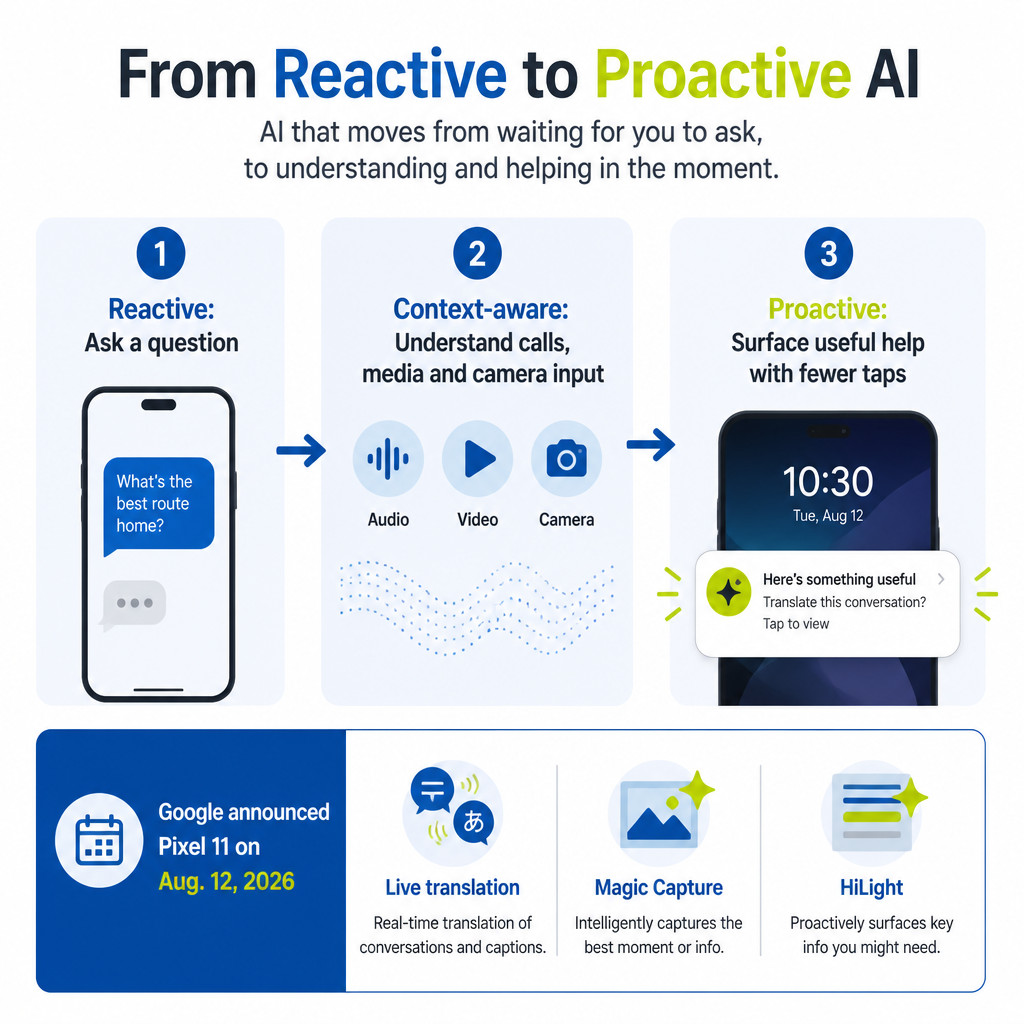
That idea came into focus on August 12, when Google unveiled the Pixel 11 lineup. Along with the expected camera and hardware updates, the company highlighted features meant to remove small points of friction. Live translation works with videos, podcasts and voice messages. A camera mode called Magic Capture records a sequence of photos and video with a single press of the shutter. Pixel 11 Pro owners also get HiLight, which assigns a color to selected contacts so the phone glows when they call while it’s lying face down.
None of these features changes the basic purpose of a phone on its own. Taken together, though, they suggest a more significant shift: smartphone AI is being sold as an action layer, not a destination app.
AI starts noticing context
The first wave of generative AI on phones was easy to spot. You opened a chatbot, typed a prompt and waited for an answer. That’s still useful, but it requires people to stop what they’re doing and decide when AI should step in.
The newer approach is more ambient. Translation appears inside media that’s already arriving on the phone. Camera intelligence begins when the photo is taken, rather than later in an editing menu. Notifications can become more visually specific instead of merely getting louder or appearing more often.
Google’s Pixel 11 launch offers a clear example because the company is connecting the experience to Gemini and its Tensor G6 chip. Google describes the lineup as built around more proactive and personalized assistance, while its product announcements put camera, communication and notification tools front and center.
Why the shift is happening now
AI fatigue is real. Consumers have watched summaries, image generators and chat interfaces spread across devices, but their practical value can still feel uneven. Phone makers now have a reason to make AI less visible and more useful, cutting down on menus, repeated steps and the need to come up with the perfect prompt.
Still, there’s no guarantee that every “proactive” feature will work for users. The gap between helpful anticipation and unwanted interruption is narrow. Translation may make media more accessible, but accuracy matters. Camera automation can help preserve a moment, though people will still want control over the finished result. Personalized alerts also can’t become one more distraction.
Trust and restraint are the real test
The emerging smartphone AI race will depend less on who can show off the flashiest model and more on who earns permission to be useful. The strongest features will quietly take care of a narrow task, make their behavior easy to understand and keep the user in control.
Google’s Pixel 11 is the latest trigger, but the broader signal matters more. Phones are being repositioned as context-aware assistants that operate around the edges of daily life. As The Associated Press reported, Google is presenting its new AI tools as a way to get things done with fewer taps and swipes. That’s a harder promise than putting a chatbot on a phone, and a more meaningful one if it works.