Encryption is often viewed as a fixed part of a system: pick an algorithm, deploy it, and move on. Cryptographic agility means being able to change that algorithm later without rebuilding or disrupting the entire service. The idea is getting more attention as organizations begin the long shift to post-quantum cryptography, or PQC.
On October 27, 2026, the U.S. National Institute of Standards and Technology published final transition guidance for moving from quantum-vulnerable public-key cryptography to PQC standards. The guidance identifies crypto agility as a practical requirement for making the transition easier to manage. (nist.gov)
What Cryptographic Agility Means
Cryptographic agility is a design approach that allows an organization to replace, add, retire, or reconfigure cryptographic algorithms while keeping its applications and infrastructure operating securely. It applies to encryption, digital signatures, key exchange, certificates, protocols, hardware, firmware, and cloud services.
In plain terms, it means a system isn’t permanently tied to one mathematical method for protecting data or proving identity.
How It Works
Agile systems begin by identifying every place cryptography is used, including websites, VPNs, databases, application programming interfaces, device firmware, and code-signing systems. Rather than hard-coding a single algorithm deep within an application, they manage cryptographic choices through defined libraries, policies, configuration, and compatible protocols.
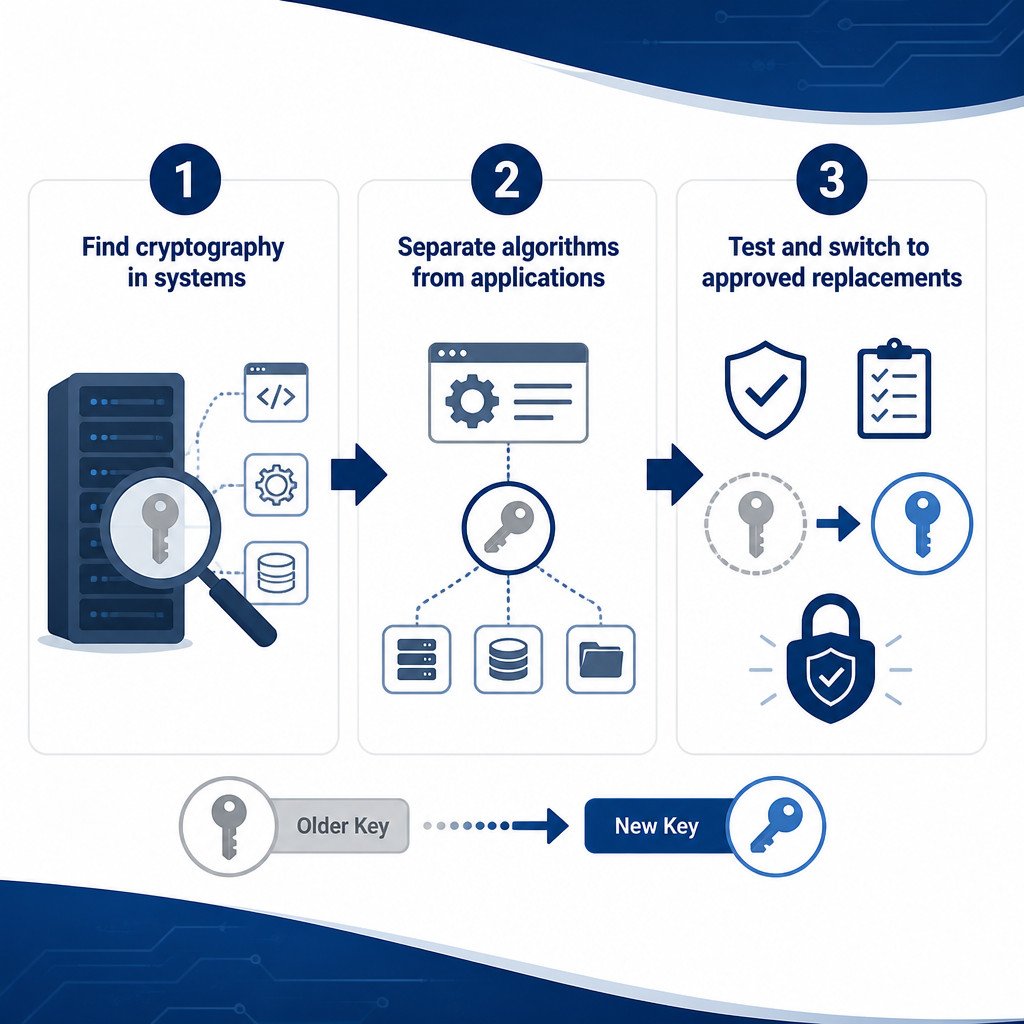
That setup allows organizations to introduce an approved replacement, test interoperability with partners and older systems, rotate keys or certificates, then eventually disable the retired option. Switching algorithms still isn’t effortless. Cryptography may be embedded throughout a supply chain. But agility makes the work planned and repeatable instead of turning it into an emergency rewrite.
Why It Matters
Algorithms can become unsafe because of new attacks, implementation flaws, regulatory changes, or advances in computing. A sufficiently capable future quantum computer could break much of the public-key cryptography in use today, which is why PQC migration is a major current concern. NIST has published standards including ML-KEM for key establishment and ML-DSA for digital signatures to support the transition. (nist.gov)
Crypto agility also supports routine security maintenance. Organizations that know where their cryptography is used and can safely update it are better positioned when standards change, certificates expire, or a widely used algorithm needs to be phased out.